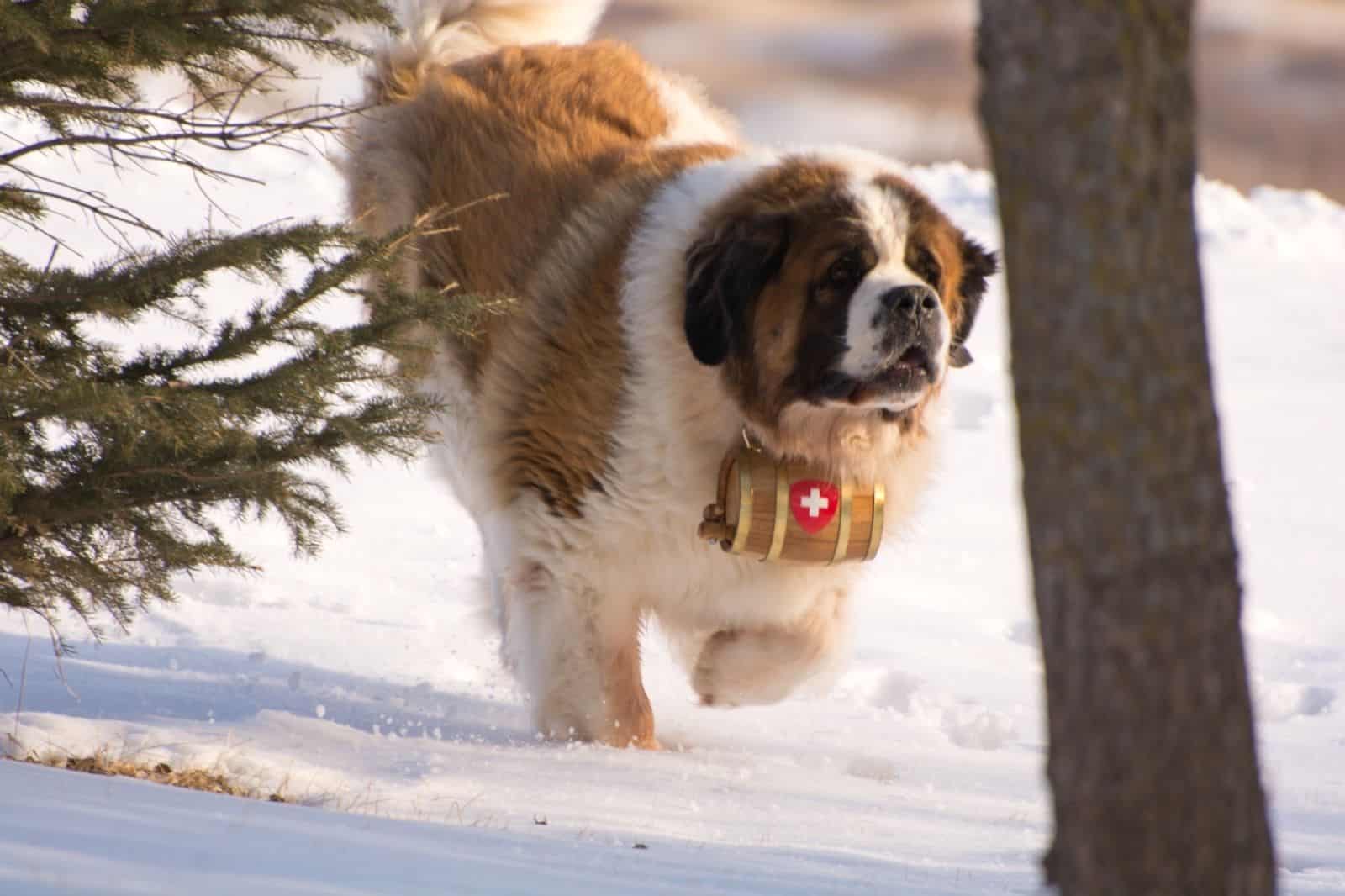
The massive Saint Bernard dogs, immortalized in Stephen King’s horror novel Cujo, are named after the Great Saint Bernard Hospice, a monastery atop the Great Saint Bernard Pass between Switzerland and Italy. The monks bred Saint Bernards in the Swiss Alps, and used them as rescue dogs. In popular culture, Saint Bernards are often depicted with a small barrel strapped to their necks, containing brandy to warm stranded mountaineers. The image is captivating, but what it depicts is just a myth. As seen below, while it is true that the giant Swiss dogs were employed in rescue operations, the monks who bred and used them never sent them out with brandy kegs tied to their necks.
The Saint Bernard With a Brandy Keg Originated in England

The first time that a Saint Bernard rescued somebody with a barrel of spirits strapped to its neck did not occur in Switzerland. Instead, it took place in England in 1820, in the art studio of then-seventeen-year-old Edwin Henry Landseer (1802 – 1873). His painting is entitled Alpine Mastiffs Reanimating a Distressed Traveler. It was the work of a teenage prodigy who was reportedly ambidextrous and could paint with both hands simultaneously.
While one of Landseer’s hands painted a dog’s head, the other would be busy painting its tail, and both would meet in the middle. The myth of rescue dogs who tote brandy kegs was created by somebody who had never been to the Alps. However, Landseer had seen and was impressed by a Saint Bernard – which had not yet gained that name – that had toured England on an exhibit.
The Origins of Saint Bernards

The Great Saint Bernard Pass has been used to cross the Alps for thousands of years. The Romans built a temple for Jupiter there, and in 1049, Saint Bernard of Menthon, patron saint of the Alps, built a hospice atop the temple’s ruins as a shelter for travelers. Monks maintained the hospice, took care of guests, and guided people through the pass. They also formed search and rescue teams for lost or injured travelers.
In the sixteenth or seventeenth century, the monks began to train large farm dogs, descendants of mastiff-type Molossian hounds introduced to the region by the Romans, as rescue dogs. Those dogs were strong, had weather-resistant coats, and possessed a strong sense of smell. That made them well-suited to guide and rescue travelers. The dogs were accompanied by monks, who sometimes had flasks of brandy and shared them with travelers. The fact that monks who sometimes shared brandy were accompanied by Saint Bernards started the association between Saint Bernard Pass rescues and brandy. Over time, that morphed into the myth of dogs carrying kegs of brandy.
Breeding Saint Bernards

Over a period of hundreds of years, from the sixteenth or seventeenth century to the early nineteenth, the monks of the Great Saint Bernard Hospice bred an excellent search and rescue dog. However, severe winters from 1816 to 1818 saw an unusually high number of avalanches, that killed many of the breeding dogs while they were performing rescue operations.
To try and save the breed, the survivors were crossed with Newfoundland dogs, imported in the 1850s. The long fur resulting from crossbreeding with the Newfoundlands – a prominent feature of modern Saint Bernards – made the dogs less suitable for rescue work. The extra fur ended up gathering snow, freezing, and weighing the dogs down.

As seen in the above painting of Barry der Menschenretter, the most famous of the Saint Bernard rescue dogs, the original dogs looked significantly different from the Saint Bernards of today. The originals who did most of the work in the breed’s heyday as rescue dogs were about half as big modern Saint Bernards – similar in size to a German Shepherd – had longer snouts, and shorter fur.
Modern Saint Bernards attained their ginormous size because kennel clubs and dog shows concentrated on appearance instead of the dogs’ working ability. As Saint Bernards became bigger and their fur grew longer, they became less suitable for Alpine rescue work. The extra weight caused them to plunge deeper into the snow, while the longer fur froze and weighed the dogs down even more.
The Greatest Saint Bernard

The most famous Saint Bernard of all was Barry der Menschenretter (1800 – 1814). He weighed about 95 pounds – significantly smaller than modern Saint Bernards, who weigh between 180 to 300 pounds. Barry gained the name Menschenretter, which means “People Rescuer”, because he reportedly saved somewhere between forty to a hundred people. His most famous rescue was of a little boy, whom he found in an ice cavern.
Barry warmed the kid sufficiently by licking him. He then maneuvered him on his back, and carried him back to the hospice. After he served twelve years with the monks, Barry was taken to Bern, Switzerland, where he retired. After his death, his body was donated to the Natural History Museum of Bern, and was preserved by taxidermy as an exhibit. A 1923 restoration altered his pose, and modified the shape of his skull to resemble the Saint Bernards of that time.
The End of an Era

Sadly, the days of heroic Saint Bernard Alpine rescues are long gone. They have been replaced with breeds better suited to avalanche search-and-rescue work, such as German Shepherds and Golden Retrievers. Among other things, those dogs have an advantage over the giant Saint Bernards. Their smaller size allows them to fit more easily in rescue helicopters. The last recorded instance of a Saint Bernard doing search-and-rescue work occurred in 1955.
Out of a sense of tradition, the big dogs were kept at the Great Saint Bernard Pass Hospice until 2004. That year, the monks sold their entire kennel of 34 Saint Bernards to local animal associations. However, they still return to the hospice every summer during tourist season. Nowadays, because the myth of the Saint-Bernard-and-brandy-barrel has become so widespread, the monks actually do outfit the dogs with cute little brandy kegs around their necks.
Giving Brandy to Freezing People Would Have Actually Done More Harm Than Good

It is commonly assumed today – and it certainly was assumed back in the day – that brandy or other strong spirits can warm you. So the notion that a freezing traveler caught up in an Alpine blizzard could be revived and warmed up with brandy makes intuitive sense. However, many things that make intuitive common sense don’t actually work as well as common sense says they ought to. In reality, the notion that alcohol warms us is just a myth.
It is true that drinking strong spirits gives a sensation of warmth. However, alcohol does not actually warm the body – the sensation is illusory. What alcohol actually does is bring our blood closer to the skin. That makes us think that we are warming up. Alcohol does not warm up our vital organs, whose failure from excessive cold could seriously harm or kill us. Bringing blood closer to the skin in the cold actually speeds up the lowering of core body temperature. That places the vital organs at greater risk. That being so, it is a good thing that Saint Bernards toting brandy barrels is a myth. Otherwise, many rescue attempts would have killed their subjects instead of save them.

________________
Some Sources & Further Reading
Beer Connoisseur – The Myth of St Bernards and Barrels
Daily Beast – The Myth of the St Bernard & the Brandy Barrel
Encyclopedia Britannica – Saint Bernard Breed of Dogs
History Halls – Hoaxes: Piltdown Man, One of History’s Most Devastating Science Pranks

