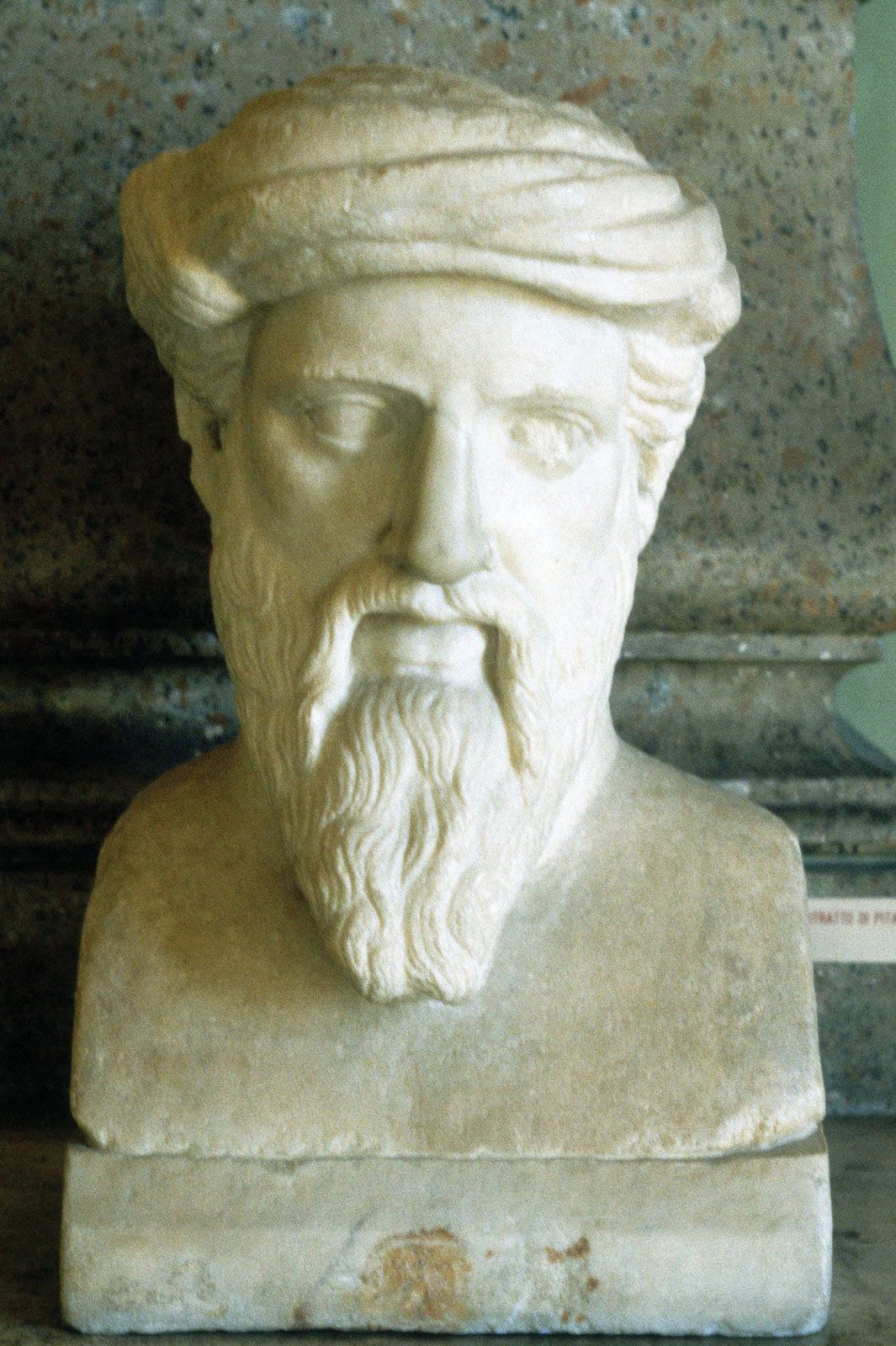
Pythagoras (circa 570 BC – circa 495 BC) is best known nowadays for his mathematical theorems. Especially the “A squared plus B squared equals C squared” bit from grade school about right angled triangles. To his contemporaries, however, Pythagoras was better known a bizarre and homicidal cult founder. As seen below, ancient Greeks saw him as mystic, as well as a murderer who believed in reincarnation and claimed the abilities to divine the future and talk to animals.
Pythagoras Had a Bevy of Bizarre Beliefs

Pythagoras liked math so much that he got his followers to worship numbers. However, his love of theorems and equations competed with his fascination with other weird notions. For example, he was a vegetarian who loathed meat, but there was one plant he would not touch: beans. He equated their consumption to cannibalism, and thought that to eat beans was morally equivalent to devouring one’s parents.
Speaking of which, Pythagoras was born in the island of Samos around 570 BC, to a woman named Pythais and, as his followers would have it, the god Apollo. He was a tall and handsome fellow with plenty of charisma, and when he turned eighteen, he left Samos to travel and expand his education. By the time his travels were over, Pythagoras had established a religious sect whose adherents viewed him as a god.

The followers of Pythagoras were not just math lovers, but extremists who outright worshiped math. His followers were literal adherents of a weird faith that revolved around numbers. Pythagoras preached that the world was based on numbers, and taught his followers that reality and the entire universe were controlled by mathematical harmonies. He also preached that math was holy, and that numbers were sacred and godlike.
The number seven, for example, was associated with wisdom, and eight was associated with justice. Ten was the universe’s holiest number, and the Pythagoreans worshipped it with a prayer that began: “Bless us divine number, who created gods and men”. Their most sacred symbol was the Tetractys, a triangle with ten points across four rows. The ancient mathematician took math so seriously that supposedly murdered his most famous acolyte, Hippasus, because of it.
Pythagoras Murdered a Follower Who Proved Him Wrong

Pythagoras’ math religion revolved around the belief that numbers explain life. Central to that was a belief that the universe could be explained by rational numbers that can be expressed as fractions. Then Hippasus demonstrated the existence of irrational numbers. Such numbers challenged and threatened to upend the worldview of Pythagoras and his followers. Unfortunately for Hippasus, although a genius, he was not very smart.
He had demonstrated his irrational numbers while on a boat that contained only himself, Pythagoras, and some Pythagoreans. Pythagoras wrestled Hippasus to the boat’s side, and dunked his head underwater until he drowned. He then tossed the corpse overboard, and warned the witnesses to never mention what they had seen or heard. That did not turn off his followers, who worshiped him as a demigod and referred to him as “the divine Pythagoras”.
Pythagoras’ Followers Thought He Was Divine

Pythagoras’ adherents thought he possessed supernatural powers that allowed him to write words on the face of the moon. They also thought his strokes could tame the wild animals of the earth and the birds of the sky, and that his voice could control them. The followers of the philosopher and mathematician claimed that he was the son of the god Apollo, or as other accounts have it, that he was fathered by the god Hermes.
As a sign of his divinity, his followers claimed that he had a golden thigh, whose shimmering sight turned doubters into believers. Pythagoras encouraged such beliefs, and claimed that the gods had blessed him with the ability to return to life after death via a divine rebirth. The weird mathematician had a weird stance on beans, especially fava beans. He thought that people lost a bit of their soul whenever they farted, which exited along with the expelled gasses.
Equating Eating Beans With Cannibalism

Pythagoras also thought that beans contained dead people’s souls, after a “scientific” experiment convinced him that humans and beans originated from the same source. Pythagoras buried beans in mud, and left them for a few weeks. When he dug them up, he saw a resemblance to human fetuses. So he convinced himself of an intimate relationship between beans and people, and reasoned that to eat beans was akin to eating human flesh.
Thus, Pythagoras equated bean consumption with cannibalism. Not just as any cannibalism, but cannibalism of one’s father and mother. As Pythagoras explained it: “Eating fava beans and gnawing on the heads of one’s parents are one and the same”. Pythagoras and his followers set up shop in Croton, whose people were forced to deal with the weird new arrivals. They crossed the line, however, when they tried to force ordinary citizens to follow Pythagoras’ beliefs.

Pythagoras and his followers tried to ban beans and meat in Croton. Unfortunately for them, that was a step too far. The good people of the Croton refused to put up with the weird new arrivals telling them what to do that, got violent, and engaged in a full on persecution of the Pythagoreans. By the time the dust had settled, many of the weird cultists had been killed, while the rest were forced to flee.
Pythagoras’ Abhorrence of Beans Cost Him His Life

The survivors of the cult of Pythagoras tried to regroup and carry on elsewhere. However, they were on a downward slide, and never achieved as much prominence or power as they had secured in Croton. The weird math misfit cult soon faded away. As to their strange leader, he was killed in the backlash against his cult, and various accounts depict his demise.
One account has Pythagoras flee for his life with angry pursuers hot on his heels, and his flight takes him to a bean field. Since he deemed beans sacred, Pythagoras said that he would rather die than step on a single bean. Die he did, when his pursuers caught up with him at the bean field’s edge, and slit his throat. In another account, the people of Croton attacked a house in which Pythagoras and his followers were conducting a meeting, and set it on fire.
Pythagoras and a small group of followers reportedly escaped and sought shelter and sanctuary in a temple. There, the strange philosopher and his followers were besieged, and eventually starved to death. In this version, he refused to eat the only food available: beans. Contra his surviving followers’ prediction, Pythagoras turned out not to be divine, and did not return from the dead.

_________________
Some Sources & Further Reading
Classical Wisdom – The Cult of Pythagoras
Daily Beast – From Communing With Animals to Obsessive Bean Hatred, Pythagoras Was One Weird Dude
Gizmodo – Was Pythagoras Really a Murderer?
History Halls – Deaths You’ll Go to Hell for Laughing At: Franz Reichelt

