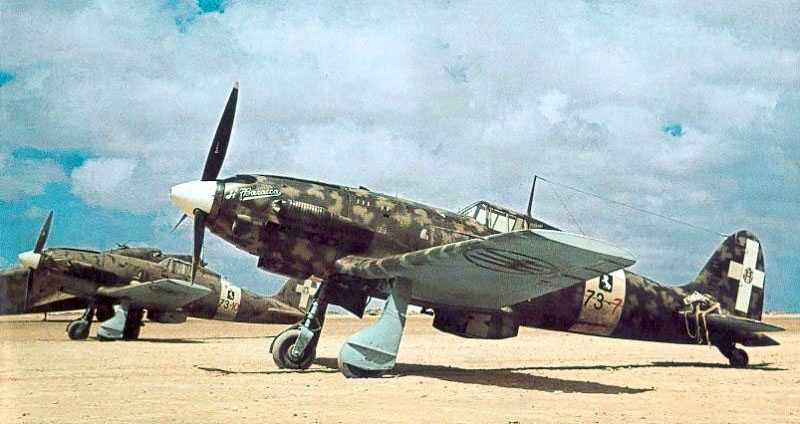
The Macchi C.202 Folgore (“Thunderbolt”) was one of Italy’s finest fighter aircraft of World War II. Developed by Aeronautica Macchi under the direction of engineer Mario Castoldi, the Folgore combined Italian aerodynamic design with a powerful German engine. That finally gave the Regia Aeronautica, Italy Royal Air Force, a fighter that could compete with Allied aircraft. Sleek, fast, and agile, the C.202 marked a turning point in Italian aviation. It represented a major leap from the earlier, underpowered radial-engine fighters that had struggled in the war’s early years.
An Italian Fighter That Could Finally Stand Up to Contemporaries

The Folgore originated as an improvement on the Macchi C.200 Saetta. The C.200 was a reliable but outdated design, hampered by its radial engine and limited top speed. In 1940, Italy obtained a license to produce the German Daimler-Benz DB 601A engine that also powered Messerschmitt’s Bf 109E. Castoldi immediately saw its potential. He designed a new streamlined fuselage around the engine, while retaining much of the C.200’s airframe. The result was the C.202 – a graceful monoplane with a liquid-cooled inline engine, retractable landing gear, and excellent handling characteristics. The prototype first flew in August, 1940, and its performance astonished test pilots. With a top speed of 372 mph or 600 km/h, it was faster and more maneuverable than any Italian fighter to date.
The first production C.202s entered service in the summer of 1941. Initially, they equipped units in North Africa and Sicily, where the Regia Aeronautica faced increasingly capable Allied opponents such as the Curtiss P-40 Warhawk, Hawker Hurricane, and Supermarine Spitfire. In combat, the Macchi C.202 Folgore quickly proved its worth. Pilots praised its superb agility, light controls, and stability in a dive. Its acceleration and turning ability gave it an edge in dogfights, especially at medium altitudes. Allied pilots often compared it favorably to the Bf 109F. Those who faced it considered it one of the most dangerous Axis fighters of the Mediterranean theater.
The Macchi C.202 Was a Great Airplane, But a Lightly Armed Fighter

Despite its excellent flying characteristics, the Macchi C.202 Folgore was under-armed compared to most contemporary fighters. The standard armament consisted of two 12.7 mm Breda-SAFAT machineguns mounted in the engine cowling and. Later models added two 7.7 mm wing guns. Against heavily built Allied aircraft, that firepower was sometimes inadequate, forcing Italian pilots to rely on accuracy and close-range attacks. Some later versions attempted to address that by installing additional 20 mm cannon pods under the wings. Those modifications were limited, however.
The C.202 served in the deserts of Libya and Egypt, the skies above Malta, Sicily, and the Italian mainland. It also served in limited numbers in the Eastern Front. In North Africa, it often escorted bombers and engaged RAF fighters. There, it had a good combat record, despite the numerical superiority of the Allies. Notable Italian aces such as Giuseppe Biron, Franco Lucchini, and Giuseppe Cenne flew the Folgore with distinction. The aircraft also saw service in the defense of Italy during the Allied invasion of 1943. It was operated by both the Regia Aeronatica, Italy’s Royal Air Force, and later the Aeronautica Nazionale Repubblicana of Mussolini’s Italian Social Republic after the armistice.
Legacy of the Macchi C.202

The Macchi C.202’s performance inspired further development, leading to its successor, the Macchi C.205 Veltro. The C.205 used the more powerful DB 605 engine, and had heavier armament. However, the Folgore remained in front-line service well into 1944 due to Italy’s limited industrial capacity, and the difficulty of producing new designs under wartime conditions. In total, around 1,150 C.202s were built – a modest number compared to other Axis fighters, but their impact was significant. The aircraft restored the reputation of Italian aviation at a critical moment, and demonstrated that Italian engineers could design machines equal to those of Germany or Britain.
The combination of elegance, speed, and maneuverability made the C.202 a favorite among Italian pilots, even if it lacked the firepower to dominate late-war opponents. Today, the Macchi C.202 Folgore is remembered as a symbol of Italian aeronautical craftsmanship. A beautifully engineered fighter, it demonstrated what Italy could achieve when its design excellence met modern technology. Sleek, responsive, and deadly in the right hands, the Folgore was one of the most respected Italian aircraft of WWII. It was a proud representative of the nation’s aviation heritage.

_________________
Some Sources & Further Reading
Gentilli, Roberto – Macchi C.202 in Action (1980)
History Halls – World War II Fighters: The Soviet Yakovlev Yak-9

