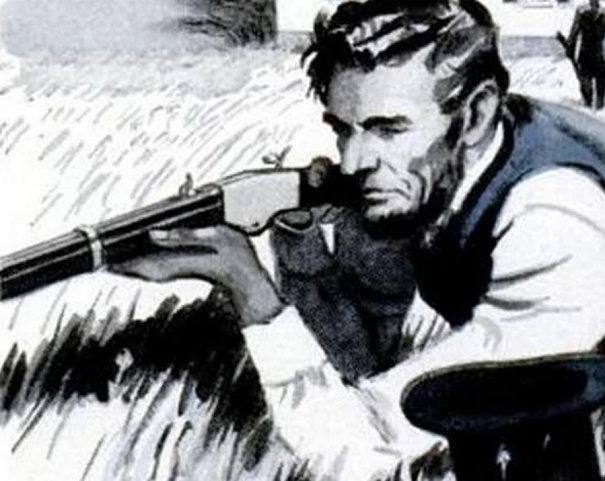
The Spencer repeating rifle was one of the American Civil War’s most remarkable technological advancements. It bridged the gap between the age of the single-shot musket, and the modern era of repeating firearms. The Spencer was the first successful repeating rifle to be adopted in significant numbers by a major army. A lever-action, magazine-fed firearm, it could fire seven metallic cartridges before needing to be reloaded – which was revolutionary. At the time, most soldiers still relied on muzzle-loading rifles that required 20 seconds or more to reload each shot.
An Ingenious Young Inventor

Christopher Miner Spencer, a young inventor and machinist from Connecticut, patented his repeating rifle design in March, 1860. His concept was both ingenious and practical. The Spencer repeating rifle used a tubular magazine built into the buttstock, that could hold seven rimfire cartridges. To fire, the shooter operated a lever located beneath the trigger guard, which performed three functions in one smooth motion. It ejected the spent cartridge, cocked the hammer, and chambered a new round from the magazine. The shooter simply pulled the trigger, and the process could be repeated as quickly as he could work the lever.
The cartridge itself was another innovation. The Spencer fired a self-contained metallic cartridge, typically the .56-56 Spencer rimfire. Spencer used a unique cartridge designation. The first number referred to the case diameter ahead of the rim, and the second to diameter at the mouth. The bullet itself was .52 inches, or 13 mm. Later variants used smaller, more efficient calibers such as the .56-50. Each cartridge consisted of a lead bullet, 45 grains/ 2.9 grams of black powder, and primer compound. All were encased in a copper shell. That eliminated the need for paper cartridges, percussion caps, and the cumbersome steps of muzzle-loading.
The Revolutionary Spencer Repeating Rifle

The Spencer repeating rifle could fire seven rounds in roughly ten seconds. Typical rifle-muskets like the Springfield Model 1861 rifle-musket could fire perhaps two or three rounds per minute in skilled hands. A skilled Spencer user could fire twenty rounds in a minute. Soldiers armed with Spencers could thus deliver sustained and accurate fire, changing the dynamics of infantry and cavalry engagements. Despite its clear superiority, Christopher Spencer’s rifle faced skepticism and bureaucratic resistance from the US Army Ordnance Department.
The department’s conservative leadership was steeped in tradition and wary of innovation. Their main argument was that soldiers would “waste ammunition” with a repeating firearm. They were also worried that supplying metallic cartridges on a large scale would be logistically impossible. To be fair, they already faced difficulties supplying ammunition for rifle-muskets that could only fire two to three per minutes. Delivering enough ammunition for a rifle that could fire ten times as many rounds was understandably daunting from their perspective.
Overcoming Bureaucratic Resistance

The Ordnance Department’s leadership was also wary of the Spencer’s relatively high production cost. It made large-scale procurement seem prohibitive in the early years of the war. Undeterred, Spencer sought to bypass the Ordnance Department and demonstrate his weapon personally to the president. In August, 1863, he arranged a meeting with Abraham Lincoln, and brought a Spencer rifle and a supply of cartridges to the White House lawn. Lincoln, an enthusiastic tinkerer and amateur inventor himself, tested the weapon personally.
Impressed by its simplicity, reliability, and rate of fire, the president ordered that the Spencer be considered for wider use. Shortly afterward, official contracts were signed for both Spencer rifles and carbines. Production began at the Spencer Repeating Rifle Company in Boston. Between 1861 and 1865, Approximately 107,000 Spencers were manufactured between 1861 – 1865. Most were carbines – shorter and lighter versions intended for cavalry use. The rifle variant, with a 30-inch barrel, was primarily issued to infantry and sharpshooter units.
Union Soldiers Loved the Spencer Repeating Rifle

Once in the field, the Spencer quickly became a favorite with soldiers. It earned a reputation for reliability, accuracy, and devastating firepower. There were other experimental side arms at the time, such as the Henry rifle and various early breechloaders. However, the Spencer was simple, robust, and able to function even when dirty or exposed to the elements. Soldiers loved it. At least Union soldiers did – Rebels at receiving end of its fire came to fear and detest the Spencer. Colonel John T. Wilder’s mounted infantry “Lightning Brigade” in the Union’s Army of the Cumberland was among the first to deploy Spencers on a large scale.
Wilder recognized the Spencer’s potential from early on. When the War Department initially refused to supply Spencers, he equipped his men out of his own pocket. His brigade’s Spencers played a decisive role in the 1863 Tullahoma Campaign, and at the Battle of Hoover’s Gap. Their rapid fire overwhelmed Confederate defenders who had never experienced the like. Confederate soldiers, unfamiliar with repeating rifles, were astonished, and some later described facing a “continuous sheet of fire”. As seen below, the Spencer carbine became particularly popular with Union cavalry units from 1863 onward.
A Devastating Rate of Fire

Cavalry engagements, characterized by mobility, skirmishes, and close-range firefights, suited the Spencer perfectly. At the Battle of Gettysburg, units such as the 5th Michigan Cavalry under George Armstrong Custer used Spencer carbines to great effect against Confederate cavalry. Later in the war, during Sherman’s March to the Sea and Wilson’s Raid, Spencer-armed cavalry dominated the battlefield. They were able to deliver devastating sustained firepower even when outnumbered. The Spencer’s key advantage was its rate of fire and reliability. It could fire twenty rounds per minute in trained hands, compared to the three rounds per minute typical of muzzle-loaders.
The Spencer’s robust action rarely jammed, and the rimfire cartridges were waterproof. That was a significant improvement over paper cartridges that could become useless when wet. The weapon’s ammunition feed system was innovative but not without flaws. Reloading the magazine required inserting seven rounds, one at a time, through a spring-loaded buttplate opening. That took time. To address that, a special accessory known as the Blakeslee cartridge box was introduced in 1864. Designed by Captain Erastus Blakeslee, it held multiple pre-loaded tubes containing seven cartridges each. They allowed soldiers to rapidly reload by simply pouring rounds into the rifle’s magazine. With a Blakeslee box, a soldier could reload all seven rounds in less than ten seconds. The rapid reload further increased what had already been an unprecedented level of sustained fire.
“Yankee Rifles That Shoot All Week!”

Despite its advantages, the Spencer repeating rifle was not by any means perfect. Its cartridges were relatively short-ranged. They also had a lower muzzle velocity than the .58 caliber Minié ball fired by the Springfield rifle-musket. That made it less effective at long distances. Moreover, its reliance on metallic cartridges made it dependent on a more complicated industrial supply chain than that which furnished ammunition for standard rifle-muskets. There was an upside to that, however. Confederate forces, lacking the capacity to manufacture rimfire ammunition, were unable to make effective use of captured Spencers.
To Confederate soldiers, an encounter with a Union unit armed with Spencer repeating rifles was a terrifying experience. Many Rebels initially mistook the weapon for multiple guns firing at once. After several defeats at the hands of Union troops armed with repeaters, Confederate generals such as Patrick Cleburne and Nathan Bedford Forrest commented bitterly on the “Yankee rifles that shoot all week!” Confederates captured some Spencers, but lack of copper and cartridge production facilities rendered them largely useless beyond occasional lucky reloads.
An Influential Design

The Spencer repeating rifle represented a profound leap in battlefield technology that foreshadowed the coming revolution in small arms. The weapon had a significant psychological impact. Union soldiers armed with Spencers felt more confident, knowing they could deliver greater volumes of fire than their opponents. That morale factor made a difference, and transformed the dynamics of small-unit engagements, ambushes, and defensive actions. In strategic terms, the Spencer hinted at the Union’s industrial might, which enabled the production and supply of tens of millions of metallic cartridges.
The Spencer symbolized the North’s capacity to merge technology, industry, and logistics – advantages that helped secure victory. When the Civil War ended in 1865, tens of thousands of Spencer rifles and carbines remained in US arsenals. Many were refurbished and reissued to frontier cavalry units during the Indian Wars of the late 1860s. Others were sold as surplus to settlers, hunters, and foreign buyers. The US Navy, which had also adopted the Spencer early on, continued to use it aboard ships and in coastal defense units.
By the early 1870s, however, the Spencer’s rimfire cartridge and tubular buttstock magazine were deemed outdated. The Springfield “Trapdoor” rifle, adopted in 1873, used a more powerful .45-70 centerfire cartridge. It reflected the US Army’s return to single-shot rifles, although one with improved breechloading mechanisms. Nevertheless, the Spencer had proven the value of repeaters. It paved the way for later designs such as the Winchester Model 1866 and Model 1873. They borrowed heavily from the Spencer, but featured faster side-loading mechanisms and better cartridges.
Legacy of the Spencer Repeating Rifle

The Spencer repeating rifle’s influence on firearms development was immense. It demonstrated that a repeating firearm could be reliable, durable, and practical for military use. Its success encouraged further experimentation and innovation. They led directly to the lever-action rifles that became iconic in both military and civilian life. More broadly, the Spencer reflected the industrial and inventive spirit of mid-nineteenth century America. Christopher Spencer went on to develop other mechanical devices and firearms improvements, but his rifle remains his most enduring legacy. The Spencer’s success also underscored how ingenuity, combined with political will, as exemplified by Lincoln’s support, could overcome institutional conservatism.
Today, original Spencer rifles and carbines are prized collectibles and museum pieces. They are often preserved in fine condition due to their solid construction. Modern reproductions allow enthusiasts and reenactors to experience firsthand the weapon that changed the face of warfare. The Spencer repeating rifle was far more than a clever invention. It was a technological revolution that changed tactics, boosted morale, and symbolized the Union’s industrial superiority during the Civil War. Though eventually superseded by newer designs, it marked a decisive turning point in the history of small arms. It was the moment when the slow, laborious musket gave way to the rapid-fire age of modern warfare.

_________________
Some Sources & Further Reading
History Halls – The Revolutionary Dreyse Needle Gun
Pritchard, Russ A. – Civil War Weapons and Equipment (2003)
Walter, John – The Rifle Story: An Illustrated History From 1776 to the Present Day (2006)

