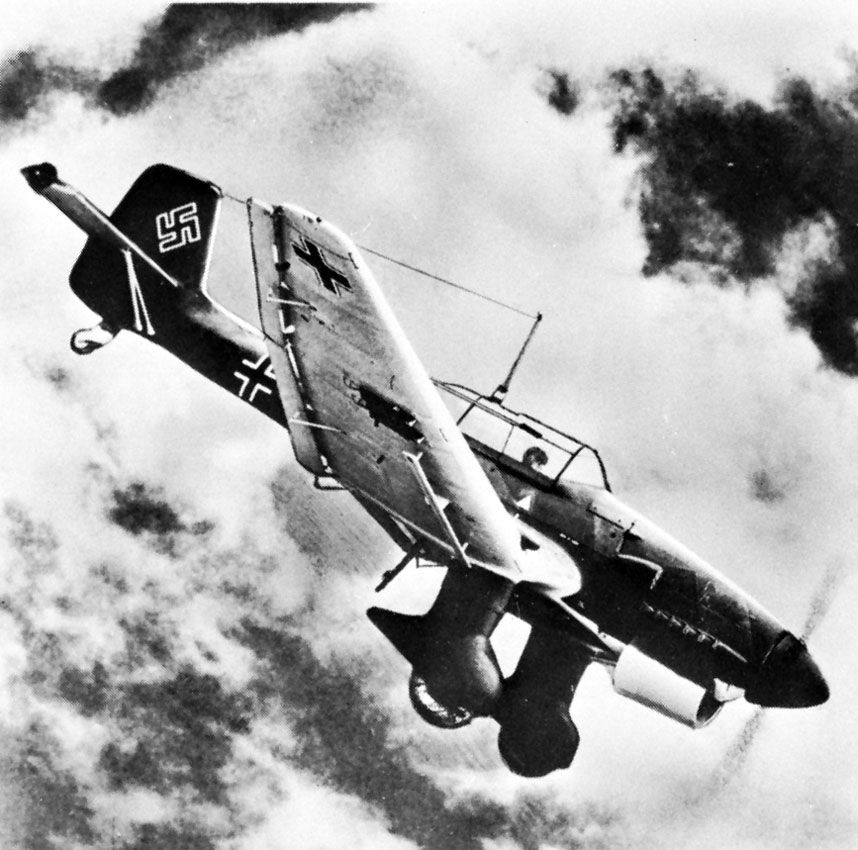
The German blitzkrieg shocked – and terrified – the world in the early days of the Second World War. One of the images – and sounds – most associated with the blitzkrieg was the chilling dive and accompanying banshee wail of Ju 87 Stuka dive bombers. Below are some fascinating fact about that, and its lesser known but even more successful sibling, the Junkers Ju 88.
The Early War’s Terror Bird

The Stuka dive bomber was the most distinctive airplane of the early war, with its inverted gull wings. Its nerve-wracking shriek as it dove on targets became the background noise of the blitzkrieg. It terrified soldiers and civilians alike, from the Russian Steppe to the Atlantic, and from the Arctic Circle to the Sahara. The Battle of Britain exposed its vulnerability when operating beyond an umbrella of German aerial superiority, but in the right conditions, Stukas continued to wreak havoc and terrorize those on the ground until war’s end.
The Junkers Ju 87 was designed in secrecy in 1933, back when Germany still pretended to comply with the Treaty of Versailles and its prohibition of a German air force. A prototype was built in Sweden, smuggled into Germany in 1934, and test flown in 1935. The inverted wings improved the pilot’s ground visibility, and allowed a shorter and sturdier undercarriage while retaining sufficient ground clearance for the propeller. Ju 87A Stukas were tested during the Spanish Civil War, with mixed results that steadily improved as designers worked out the kinks and personnel gained operational experience.

Deadly Accuracy

The Ju 87B version of the Stuka with which Germany entered WWII was typically armed with a 500 kilogram bomb, and had wind-driven sirens known as “Jericho Trumpets” that emitted an intimidating and demoralizing wail when the plane dove. That demoralizing effect was enhanced by cardboard sirens affixed to the bombs. The Stuka’s bombload was increased to 1800 kg in the upgraded Ju 87D, which entered service in 1941. The Ju 87G, which became operational in 1943, carried two armor-piercing 37mm cannons in lieu of bombs.
The Ju 87G proved especially lethal against tanks, whose thinner top armor was vulnerable to attacks from above. The Stuka’s greatest asset was its pinpoint accuracy by WWII standards. In the hands of an experienced pilot, it could destroy a zigzagging target – Germany’s most decorated serviceman of the war, Hans-Ulrich Rudel, is credited with destroying 519 tanks, over 800 vehicles, 150 artillery positions, damaging a battleship, sinking a cruiser, a destroyer, 70 other seacraft, and downing 9 airplanes, mostly while flying a Stuka.

Some Sources and Further Reading
Boyne, Walter J. – Clash of Wings: Air Power in World War II (1994)
Griehl, Manfred – Junkers Ju 87 Stuka (2001)
History Halls – World War II Bombers: Japan’s G4M Betty

