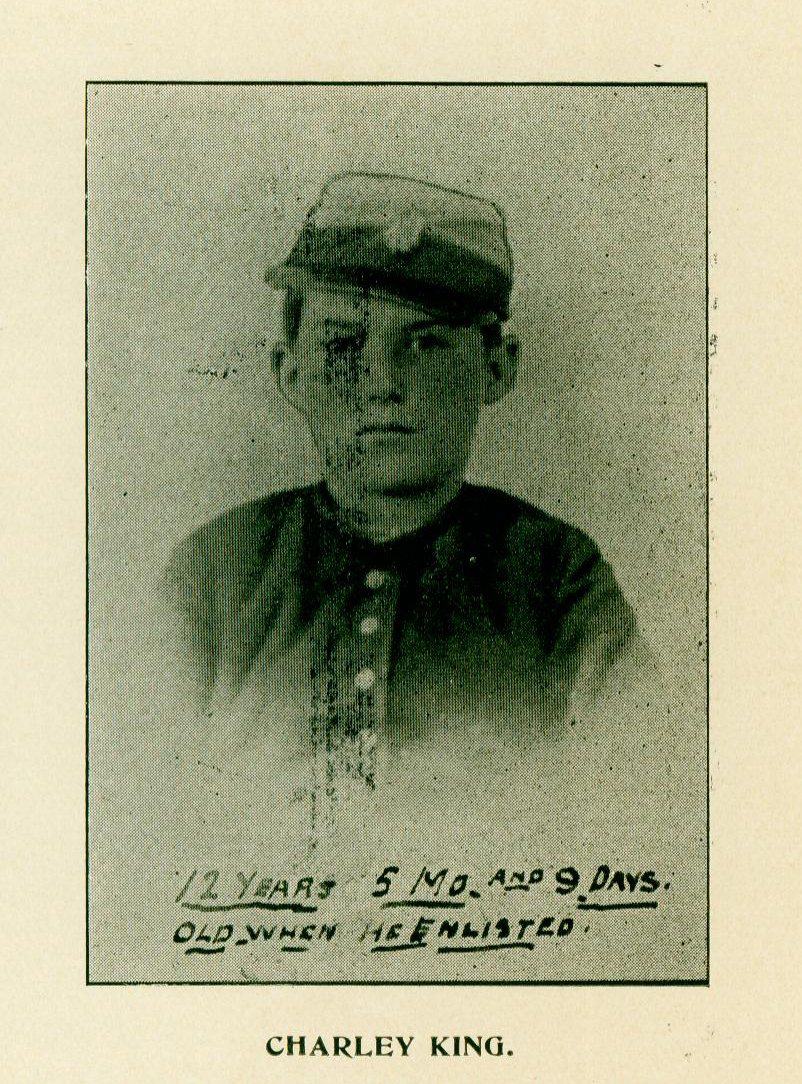
Charles Edwin King joined the Union Army during the Civil War as a drummer boy at age twelve. Unfortunately, not all accounts of precocious young child soldiers have a happy or uplifting ending. Charley, as he was nicknamed, ended up with the unfortunate distinction of becoming the Civil War’s youngest confirmed fatality.
A Precocious Child Soldier

Charles Edwin King was born in 1849 in West Chester, Pennsylvania. He was twelve when the Confederate bombardment and capture of Fort Sumter in April, 1861, inaugurated the US Civil War. Many locals stepped forward when President Lincoln issued a call for ninety-day volunteers to help defend the Union. West Chester raised a company, part of the 9th Pennsylvania Volunteer Infantry Regiment, and Charley joined as its drummer boy. They departed for training camps at Harrisburg, for what was expected to be a short war.
When the militia were ordered to the front, however, Charley’s parents ordered their son back home to the safety of West Chester. He was not happy. Charley moped, and pined for the excitement of the military camp. At the end of their three-month enlistment, the militia returned home. By then, it was clear that the war would not be as short as many had predicted and hoped. So volunteers were again sought, this time for three year terms in the newly formed 49th Pennsylvania Volunteer Infantry Regiment.
Benjamin Sweeney, West Chester’s grocer, was elected captain of the 49th Pennsylvania’s Company F. He assured Charlie’s parents that he would look after their son if they allowed him to enlist. Between their sons’ incessant pleas and Sweeney’s assurances, Charley’s parents relented. Among other things, they feared that he might run away and enlist on his own, as other boys had done. So they reasoned that letting him enlist with in the care of somebody they trusted was the lesser evil.
Charles Edwin King at the Battle of Antietam

Charley officially joined the muster of the 49th Pennsylvania Volunteer Infantry Regiment as a drummer boy on September 12th, 1861. He was twelve-years-old. Charley had musical talent and a good disposition. Within a short while, he received a promotion from Company F’s drummer boy to drum major of the entire regiment. The 49th Pennsylvania fought in the Peninsula Campaign and the Seven Days Battles. In those battles, Charley saw more carnage than he might have imagined in his boyish fantasies.
The 49th Pennsylvania fought in the Maryland Campaign in the fall of 1862. It culminated in the Battle of Antietam on September 17th, 1862. It was the single bloodiest day not only of the Civil War, but of all of American history. The regiment was deployed near the East Wood and Miller’s Field and the East Woods. It was subjected to Rebel artillery fire, and took what was described as relatively light casualties. They were not “light”, though, for those who were hit, and unfortunately for Charley, he was one of them. A shell exploded nearby, and he was fatally wounded. He was taken to a field hospital, but there was little to be done to save his life. He succumbed to his injuries three days later. Charles Edwin King became the youngest confirmed military combat fatality of either side during the Civil War.

_________________
Some Sources & Further Reading
Downtown West Chester – Charley: The Youngest Soldier to Die in Battle
Find a Grave – Charles Edwin “Charlie” King (1849 – 1862)
History Halls – John Lincoln Clem: The US Army’s Youngest Sergeant
Keesee, Dennis M. – Too Young to Die: Boy Soldiers of the Union Army, 1861-1865 (2001)

