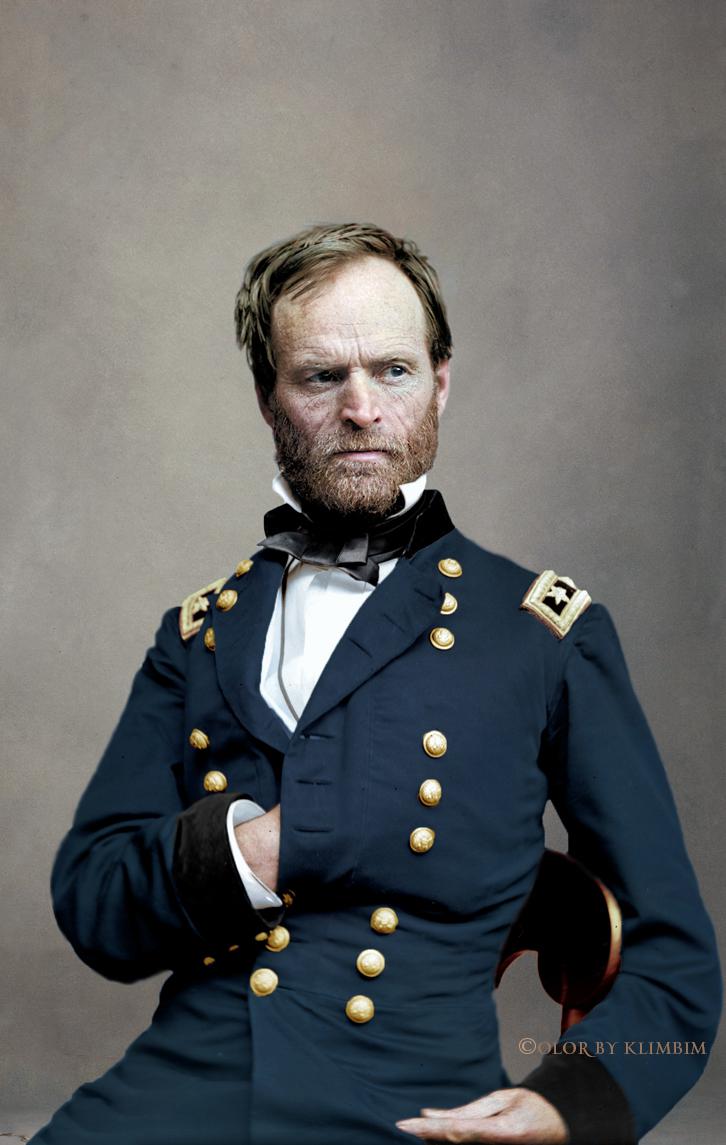
William Tecumseh Sherman is best known for his march through Georgia in late 1864, when his men lived off the land, wrought widespread destruction, and drove home the Confederacy’s hopelessness. It cemented Sherman’s place as a Union, and established his reputation as a pioneer of modern total war. Simultaneously, it enshrined Sherman’s as a villain in Southern minds. However, the march through Georgia was not Sherman’s sole rampage through the South. An even more destructive march took place in early 1865, when Sherman’s men tramped through South Carolina – a state widely blamed for starting the Civil War.
America’s Most Hated State

If pre Civil War America had a problem child state, it was South Carolina. South Carolinians constantly instigated, threatened to secede, and vowed violence upon those who spoke ill of slavery. A South Carolina Congressman once nearly caned an abolitionist Northern Senator to death inside the Senate, and became a state hero. As a result, Palmetto State politicians gained reputations as firebrands. Decades before it left the Union in 1860, South Carolina had threatened to secede in the early 1830s in what came to be known as the Nullification Crisis. Things calmed down only after then-president Andrew Jackson promised to march into the state and hang people left and right.
There was no Andrew Jackson around in 1860. Soon after Abraham Lincoln won that year’s presidential election, South Carolina’s General Assembly declared the Republican’s victory a “hostile act”, and called a convention to consider secession. The convention’s delegates voted unanimously to secede, and South Carolina became the first slave state to leave the Union. That kicked off a chain of events that ended in the US Civil War – America’s bloodiest conflict, ever. No wonder, then, that South Carolina became America’s most hated state. Hated not just by Northerners, but, as the war dragged on its consequences came home, by Southerners as well.
Why South Carolina Split From the Union

The “Declaration of the Immediate Cause Which Induce and Justify the Secession of South Carolina From the Federal Union” left little doubt about why the state left the Union: slavery. It read in relevant part: “We affirm that these ends for which this Government was instituted have been defeated, and the Government itself has been made destructive of them by the action of the non-slaveholding States.
Those States have assume the right of deciding upon the propriety of our domestic institutions; and have denied the rights of property established in fifteen of the States and recognized by the Constitution; they have denounced as sinful the institution of slavery; they have permitted open establishment among them of societies, whose avowed object is to disturb the peace and to eloign the property of the citizens of other States. They have encouraged and assisted thousands of our slaves to leave their homes; and those who remain, have been incited by emissaries, books and pictures to servile insurrection.“
Four years later, the Civil War kicked off by South Carolina’s secession was going badly for the south, as Union armies pushed ever deeper into the Confederacy. As 1864 turned into 1865, General William Tecumseh Sherman had just finished leading a Union army through Georgia, and devastating much of that state in the process. Most of Sherman’s men would probably have preferred to be back home with their families and loved ones, going about their daily lives and peaceful pursuits. But if they absolutely had to be somewhere other than home, inflicting misery, wreaking havoc, despoiling the country, and tearing up and burning stuff, most would have preferred that somewhere be South Carolina.
The Desire to Make the Civil War’s Instigators Suffer

The opportunity to tear up and burn stuff in South Carolina finally came around. By then, the country had endured four years of a terrible war. A war that had been kicked off by South Carolina’s secession. A war whose first shot had been fired when Secessionists bombarded the federal Fort Sumter in Charleston Harbor, SC, to the cheers of South Carolinian spectators. Unsurprisingly, most Northerners nursed a deep hatred of the Palmetto State. That went double for the Union soldiers who bore the brunt of the resultant war. By the war’s final year, most Yankee soldiers relished the opportunity to visit South Carolina for a reckoning. They wanted to drive home to its residents that war was no game to be cheered.
The march of William Tecumseh Sherman through Georgia ended on December 21st, 1864, with the capture of Savannah. It capped a month long campaign, in which 62,000 Union troops had left Atlanta a smoldering ruin behind them. They then divided into two columns, abandoned their supply lines and plunged into the Peach State. In Sherman’s words, his aim was to “make Georgia howl“. Howl it did. Sherman’s men advanced along a sixty mile front, and wrecked military targets along the way. They destroyed Confederate industry and infrastructure, all the while living off the land and looting civilian property. It was incontrovertible proof that the Confederacy had been reduced to a hollow shell, unable to protect its heartland or citizens from whatever an enemy wanted to do.
William Tecumseh Sherman and His Men Wanted to Make South Carolina Suffer

After the fall of Savannah, Ulysses S. Grant, the Union army’s general-in-chief, wanted Sherman and his men to board ship and join him in Virginia, to help seal the fate of Robert E. Lee’s Confederate forces there. Sherman had a better idea: instead of sail north to Virginia, why not march there, through the Carolinas, and wreck South Carolina – birthplace of secession and the war – while he was at it? After all, the recently concluded march through Georgia had demonstrated that a Union army could march wherever it wanted in the Confederacy. Grant eventually agreed, and in late January, 1865, Sherman led about 60,000 Yankees out of Georgia and into South Carolina.
Many in the Confederacy had anticipated that. As one Southern diarist put it “Georgia has been desolated. They are preparing to hurl destruction upon the State they hate most of all, and Sherman the brute avows his intention of converting South Carolina into a wilderness“. Some southerners had less sympathy for the Palmetto State. As Union soldiers crossed the state line into South Carolina, some Georgians, eager to share their misery, asked Sherman’s men to treat South Carolina like they had Georgia. After all, South Carolinians had started the war. If Georgia was to suffer, it was only fair that the war’s instigators should suffer as well. Sherman’s men needed no urging.
The Decision to March Through the Carolinas

While they were in Georgia, Union soldiers had behaved as if they were on a lark. The Yankees despoiled the countryside and visited destruction upon the locals in a nearly light hearted manner. They were kind of like schoolboys. Deadly and dangerous schoolboys, let loose to engage in some youthful high jinx. They had engaged in widespread vandalism and wrought widespread devastation, but did so in a fun filled (to them) atmosphere, devoid of widespread malice or particular hatred towards their victims.
The attitude of mischief without malice vanished once the gaze of Sherman’s veterans turned north. Things were different once they crossed the state line into South Carolina. Many noted how a change in attitude descended upon the Union soldiers once they entered the “lair of secession”. Many of them might have gone about wrecking Georgia light heartedly. When it came to South Carolina, though, they entered that state with a grim determination that it should pay. As seen below, they made it pay with plenty of malice aforethought.
When Real War Finally Reached South Carolina

When the Union forces finally set foot in South Carolina, 60,000 hardened Northern veterans were faced with 20,000 armed Confederates. Most of the Southern foes were poorly trained boys and old men. Sherman saw poetic justice in what was about to happen to the state that had seceded first, and that had been the site of the war’s first shot. It was an attitude fully shared by his men.
As Sherman wrote: “The whole army is burning with an insatiable desire to wreak vengeance upon South Carolina. I almost tremble at her fate, but feel that she deserves all that seems in store for her“. The Union general divided his army into two wings, both of which wrecked and burned with a will far that exceeded anything that the Yankees had exhibited during their march through Georgia.

Railroads and other infrastructure deemed of any military value were destroyed, and South Carolinans went hungry after thy lost their winter stores to Union foragers. Outright murder and violent moral offenses against women were rare, but civilians had their property plundered and their valuables stolen. Women were humiliated, and the gratuitous destruction and burning of homes – particularly those of prosperous planters – was widespread.
An obvious target for the Yankees’ wrath was Charleston, site of the Fort Sumter bombardment that had kicked off the war. Sherman feinted with his right wing towards Charleston, while feinting with the left towards Augusta, the site of important arms and munitions factories. That juked the Confederate defenders under General P.G.T. Beauregard to fortify and reinforce both Charleston and Augusta. As seen below, that was perfectly fine with Sherman.
Making South Carolina Pay

Once the Confederates were tricked to concentrate their forces at Augusts and Charleston, Sherman brought his wings back together, and marched straight north to South Carolina’s capital, Columbia. Columbia was protected by natural barriers of swamps and rivers. The roads that led to the city, subjected to heavy winter rains, were thought to be impassable. Sherman’s men took the obstacles in stride.
They threw pontoon bridges across rivers and creeks, waded through swamps, and chopped down trees by the thousands for logs with which to corduroy the muddy roads. They averaged a dozen miles a day, causing Confederate general Joseph E. Johnston to remark that “there had been no such army in existence since the days of Julius Caesar“. Union forces captured Columbia on February 17th, 1865. That night, the city went up in flames, in a conflagration that destroyed its center.
The Blame for the Destruction Visited Upon South Carolina
The fiery devastation of Columbia has been a controversial whodunit ever since. Southerners naturally blamed Sherman. He blamed the city’s defenders for leaving burning cotton bales in the streets when they left, winds that fanned the flames, and locals who foolishly gave his troops alcohol. While declining responsibility, Sherman made it clear then and thereafter that he felt little sympathy for the city’s fate. Columbia was not the only South Carolinian town put to the torch along Sherman’s path – just the biggest one. Towns such as Winnsboro, Orangeburg, Barnwell, and sundry smaller communities, also suffered, as the war for which South Carolinian fire eaters had clamored for decades finally came to their state with a vengeance. The army’s rough hand did not soften until it crossed into North Carolina, at which point Sherman ordered his men to treat it less vindictively than they had treated the “lair of secession”.
_________________
Some Sources & Further Reading
American Battlefield Trust – William T. Sherman
Catton, Bruce – This Hallowed Ground (1956)
Foote, Shelby – The Civil War: A Narrative, Vol. 3, Red River to Appomattox (1974)
History Halls – The Men Who Made Ancient Athens: Solon
South Carolina Encyclopedia – Sherman’s March, February 1, 1865 – March, 1865
William Tecumseh Sherman – Memoirs of General W.T. Sherman (1990 ed.)

