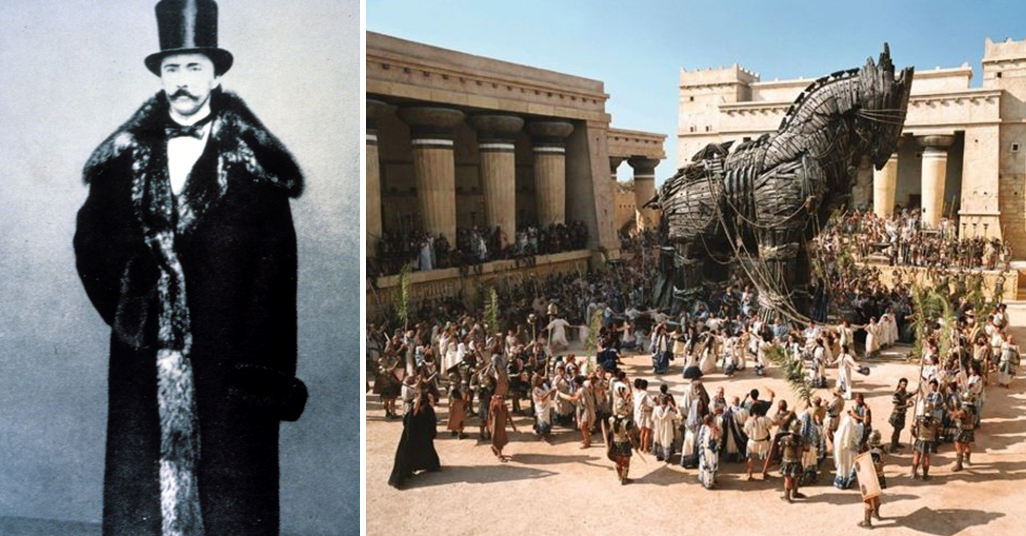
Heinrich Schliemann (1822 – 1890) was one of the most controversial and influential figures in archaeology’s history. A self-made businessman turned self-taught archaeologist, Schliemann is best remembered for his discovery of the ancient city of Troy, long thought by many scholars to be a myth described only in Homer’s Iliad. His work at Hisarlik, in today’s Turkey, changed the way people think about the intersection between myth and history. It also sparked heated debates about his methods, ethics, and interpretations.
An Unlikely Archaeologist

Heinrich Schliemann was born on January 6th, 1822, in Neubukow, in the Grand Duchy of Mecklenburg-Schwerin in modern Germany. His father, a poor Protestant pastor, encouraged his son’s love of ancient history and the Greek classics. According to Schliemann’s own later accounts – though some details are likely embellished – his fascination with Homer’s Iliad began at the age of seven, when he received a picture book about the fall of Troy. He allegedly vowed as a child to find the city someday, an ambition that would define his life.
Despite his interest in ancient history, Schliemann’s early life offered little opportunity for scholarship. Higher education at the time was practically the exclusive preserve of those with means, and Schliemann was without. His family’s poverty forced him to leave school at age fourteen to work as an apprentice in a grocery store. However, his determination and linguistic ability eventually opened other doors. He taught himself numerous languages, including Greek, Latin, English, French, Dutch, Spanish, and Russian. He eventually mastered more than a dozen. That talent helped him rise rapidly in the world of international trade.
Amassing the Funds to Fulfill a Dream

In the 1840s and 1850s, Heinrich Schliemann built a fortune through business ventures. He plied his talents first in the Netherlands, then in Russia, and finally in California. Schliemann made substantial profits During the California Gold Rush, not from digging for gold, but by trading commodities and banking. He hastily left California, claiming ill health, amidst a swirl of suspicions that he had been shortchanging people on gold dust tallies. By his mid-forties, he had made enough to retire and pursue his lifelong dream: to uncover the world of Homer. In the 1860s, Schliemann shifted his attention from commerce to archaeology, even though he lacked any experience or formal training in the field. He began to travel extensively in Greece and Asia Minor, and visited many ancient sites described in classical texts.
Schliemann’s ambition was to prove that the Trojan War had a historical basis. He was convinced that Homer’s Iliad was rooted in real life events, not just myth. At the time, most scholars believed that Troy was as fabled and mythical a city as El Dorado. The few who entertained the possibility that it might have actually existed believed that it would have been located somewhere along the western coast of Asia Minor, near the Dardanelles. Several sites had been proposed, but no evidence was found to back up such proposals. Schliemann, guided more by his reading of Homer than by archaeological reasoning, focused on a mound called Hisarlik, near the modern Turkish village of Tevfikiye.
Heinrich Schliemann Discovered Troy – With Some Caveats

In 1822, decades before Heinrich Schliemann got started on his archaeological digs, British amateur archaeologist Charles Maclaren had suggested Hisarlik as a potential site for Troy. In the 1860s, British archaeologist Frank Calvert began to excavate there. Calvert’s family owned part of the land, and he was convinced that it held the ruins of Troy. When Schliemann arrived in 1868, Calvert showed him the site, and encouraged him to dig there. Though Calvert played an essential role, Schliemann later minimized his contribution, and claimed most of the credit for the subsequent discoveries.
Schliemann began large-scale excavations at Hisarlik in 1870 – without bothering to secure permits from the authorities. His enthusiasm was matched only by his lack of archaeological training. Determined to reach what he believed was Homer’s Troy, he directed hundreds of local laborers to dig massive trenches straight through the mound. Schliemann’s methods are cited today as cautionary examples of what not to do. In his haste, he demolished much of the site’s upper layers, consisting of remnants of various cities that had been built atop earlier settlements, to reach what he considered to be the oldest and most important stratum. In reality, Schliemann ended up destroying most of the likeliest candidate for Homer’s Troy, in his eagerness to reach a layer he was convinced was the city from the Iliad, but that was actually not.
Discovering – and Destroying – Troy

In 1873, Schliemann announced that he had discovered “Priam’s Treasure” – a cache of gold, silver, and bronze objects that he believed had belonged to the legendary King Priam of Troy. The treasure included diadems, goblets, earrings, and other precious items. Schliemann dramatically described how his wife, Sophia, helped him secretly carry the artifacts away from the Ottoman authorities by hiding them in her shawl – a romanticized tale that was later revealed to be fictional. Modern archaeology has since shown that the objects belonged not to Priam’s Troy, which dates to around 1250 BC, but to a much earlier settlement, now called Troy II, dating to around 2500 BC.
Heinrich Schliemann had, in effect, dug too deep, and too recklessly. He had actually come across Priam’s palace, but not recognizing it for what it was, destroyed it to reach a lower stratum that he mistakenly thought was Homer’s Troy. As one archaeology historian put it: “If you look on excavation maps, there’s a gap in the middle where it says ‘Palace removed by Schliemann’ … He got Priam’s palace and then threw it away. He found Troy, but he also destroyed Troy”.
Nonetheless, Schliemann’s discovery captured the world’s imagination and convinced many that Troy had been a real city. His triumph was shadowed by controversy, though. The Ottoman government accused him of smuggling the treasure out of the country illegally, leading to a court dispute. He was later fined and forced to return some of the artifacts, though many ended up in European museums. Today, much of the so-called Priam’s Treasure is housed in the Pushkin Museum in Moscow, after it was seized the Soviets when they conquered Berlin at the end of World War II.
Destructive, but Revolutionary

Archaeologists have been highly critical of Schliemann’s destructive methods. His deep trenches and lack of stratigraphic recording caused irreparable damage to the site. Later excavations revealed that Hisarlik contained at least nine major layers of occupation, representing successive cities built one on top of another. Schliemann’s reckless digging obliterated much of the evidence from these layers, and made interpretation difficult. Despite such failings, however, Schliemann’s work was revolutionary. He proved that the site of Hisarlik had been occupied for thousands of years, and that a significant city had existed there during the Late Bronze Age – the period traditionally associated with the Trojan War.
Schliemann’s discoveries lent new credibility to the idea that Homer’s epics preserved echoes of real historical events. After his work at Troy, Schliemann turned his attention to mainland Greece. In 1876, he began to excavate at Mycenae, another site famous in Greek legend as the home of King Agamemnon, the leader of the Greek forces in the Trojan War. There, he discovered a series of royal shaft graves containing gold death masks, jewelry, weapons, and other treasures. One mask in particular – a gold funerary mask – he declared to be the “Mask of Agamemnon”.
Heinrich Schliemann in Greece

As with Troy, Heinrich Schliemann’s identification of the Mask of Agamemnon was mistaken. He had discovered the burial and funerary mask of a Mycenaean king, but other than wishful thinking, there was no reason for him to conclude that it was the burial and funerary mask of the Mycenaean king from Homer’s Iliad. Nonetheless, the discoveries were extraordinary. The finds at Mycenae revealed a sophisticated Bronze Age civilization previously unknown to scholars. It would later be called the Mycenaean civilization.
This time around, Schliemann’s excavations were conducted under the supervision of professionals from the Greek Archaeological Society. It marked a turning point toward more systematic methods, although he still prioritized drama and self-promotion over accuracy. Heinrich Schliemann passed away in 1890, having transformed himself from a wealthy businessman into his era’s most famous archaeologist. His work inspired new interest in the ancient world, and laid the foundation for the field of Aegean archaeology. It was later refined by scholars such as Carl Blegen, Wilhelm Dorpfeld, and Arthur Evans.
The Complex Legacy of Heinrich Schliemann

Schliemann’s legacy remains complex. On one hand, he was a pioneer who demonstrated that myth and history are often intertwined, and that literature like Homer’s Iliad could preserve memories of real places and cultures. His discoveries at Troy and Mycenae opened the door to a new understanding of Bronze Age Greece and the eastern Mediterranean. On the other hand, Schliemann’s methods were crude by modern standards. His obsession with proving Homer literally true led him to misidentify artifacts, exaggerate findings, and destroy valuable archaeological evidence. His tendency to dramatize his discoveries also blurred the line between scholarship and showmanship.
Despite his flaws, Heinrich Schliemann remains one of the most compelling figures in the history of archaeology. His determination, imagination, and audacity reshaped our understanding of the ancient world. Through his excavations at Hisarlik and Mycenae, he bridged the world of myth and history. He revealed that Homer’s stories were not pure invention, but echoes of a long-lost civilization. While modern archaeologists have corrected many of his errors, Schliemann’s bold belief, that buried beneath centuries of legend lay the truth of ancient Troy, proved prophetic. His life’s work reminds us that discovery often begins not with certainty, but with vision and the courage to chase a dream.

_________________
Some Sources & Further Reading
Classical World, Vol. 91, No. 5, (May – Jun. 1998) – Heinrich Schliemann: Hero or Fraud?
Traill, David A. – Schliemann of Troy: Treasure and Deceit (1995)
Wood, Michael – In Search of the Trojan War (1987)
If you liked this article, you will probably like Midas, and the Real Life King Who Inspired the Mythology

