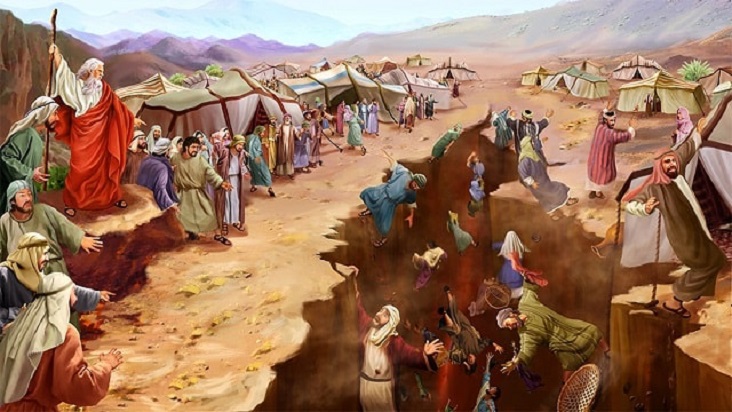
Many biblical narratives can serve as historic texts. Not necessarily for the accuracy of what they say, but as a window into the mindsets of the people who wrote them, and the political and cultural landscape of their era. One of the more interesting biblical texts is the divine punishment of Korah, described in the Old Testament. Some ancient Israelities upset God, so he had the earth swallow some of them, sent a fire to torch others, and inflicted a plague upon everybody else when they complained that the punishments might have been extreme. So what was the historic and political context of the punishment of Korah narrative?
The Old Testament’s Korah Narrative

In the Old Testament’s Book of Numbers, chapter 16, there is a narrative about the consequences of rebellion against those appointed by God to lead. Korah, a Levite (a member of the ancient Israelite tribe of Levi) was a cousin of Moses and his brother Aaron. He, along with Dathan, Abiram, and On from the tribe of Reuben, and supported by 250 leading Israelites, where unhappy with their leaders. They argued that all Israelites were holy, questioned the special status of Moses and Aaron, and wanted to know why they had elevated themselves above everybody else. Moses responded by proposing a test: the rebels and Aaron would each present censers with incense before Yahweh, and He would indicate His chosen leader.
The next day, as the community gathered at the Tent of Meeting, God’s presence appeared, and He was angry. God ordered Moses and Aaron to separate themselves from the Israelities, so He could destroy them. Moses and Aaron begged Him to have mercy, and God heeded their plea – at least in part. He declared that He would spare the rebels, but not their leaders. God ordered the Israelites to distance themselves from the tents of Korah, Dathan, and Abiram, and Moses declared that if these men died of natural causes, it would mean he was not sent by God. If the earth opened up and swallowed them, however, it would demonstrate that they had offended the Lord. As seen below, the story’s setup was a clear sign of what was about to happen to the named men.
A Political Statement About Unity and Obeying the Leadership

As soon as Moses finished speaking, the ground opened up and swallowed up the rebels, their families, and possessions. Simultaneously, God sent a fire that consumed the 250 men challenging Aaron in the incense competition. Per the Old Testament, after God destroyed the rebels, He ordered that the bronze censers used by the 250 men who had challenged Aaron be hammered into a cover for the Altar. It was intended to commemorate what had happened, and serve as a reminder that the Yahweh would only accept incense from Aaron or his descendants.
The next day, the Israelites grumbled about Moses and Aaron, and blamed them for the deaths of so many. God grew angry again, and threatened to destroy the entire assembly, but Moses and Aaron once more begged Him for mercy. God, however, had already sent a plague. Aaron made atonement for the people, and stood between the living and the dead until the plague passed. By then, 14,700 people had lost their lives. To the ancient Israelites, the Korah narratives was not just about faith, but was also a political statement about the maintenance of unity, and the importance of obeying those appointed by God to lead.

_________________
Some Sources & Further Reading
American Jewish University – What Did Korah Do Wrong?
Chabad – The Story of Korah in the Bible
Day, John – Yahweh and the Gods and Goddesses of Canaan (2002)

