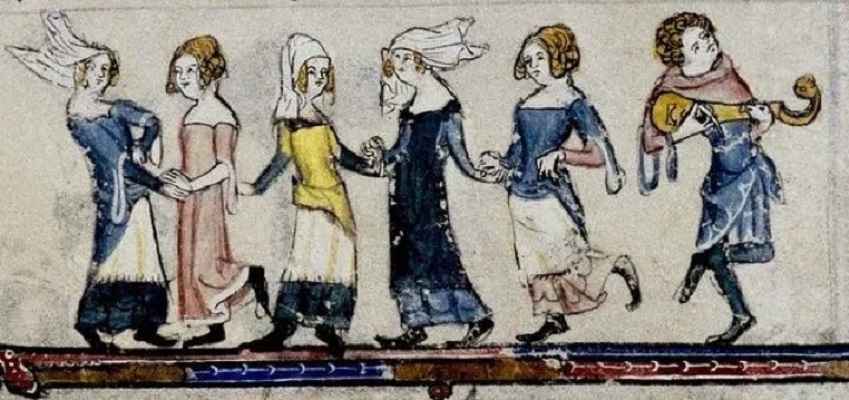
The dance marathons of the 1920s and 1930s might have been extreme and a bit crazy. However, they were pretty mild compared to the dance marathons of the Middle Ages. The Roaring Twenties and Great Depressing era dance marathons were what we might call “dance ’til you drop” affairs. Their Medieval predecessors were literal “dance ’til you die” events.
Medieval Compulsive Dancing

Everybody gets a tune stuck in the head sometimes, that just won’t go away as we find ourselves humming it for hours or days on end. But what if it is not just a tune that one can’t stop humming, but a dance that one just can’t quit? Just about everybody loves a good shimmy, but what happens if the shimmy is so good that you just can’t stop, have to keep on dancing, and end up boogeying yourself to death?
Worse yet: what if it is not just you, but dozens, hundreds, or thousands of people, gathered together in a literal dance to the death? That happened often enough in the Middle Ages and Renaissance period, especially between the fourteenth and seventeenth centuries, that a term was coined for the phenomenon: Saint Vitus or Saint John’s Dance. The best known example occurred in Strasbourg, in what is now Alsace, France, in July of 1518. As seen below, it was pretty wild.
The Strasbourg Dance Craze

In July, 1518, the Alsatian town of Strasbourg was swept by a dance craze, as hundreds of people began to dance nonstop, for days on end. By the time the dance fever finally broke, many participants had literally danced themselves to death from heart attacks, strokes, or sheer exhaustion. The madness started innocently enough, when a housewife started dancing in the street. Her neighbors clapped, laughed, and cheered her high spirits and joie de vivre as she danced.
The housewife danced. And danced, and danced, and then danced some more, without cease or letup. The woman continued to dance, without rest or respite, for six days straight. Within days, she was joined by dozens in her marathon dance, mostly women. That alarmed the authorities, who consulted physicians. Their prognosis was that the dance craze was caused by “hot blood”, which the dancers had to get out of their system. So, as seen below, Strasbourg’s authorities made it easier for the dancers to keep on dancing.
The Middle Ages Witnessed Many Dance Plagues

Per the medical professionals consulted by Strasbourg officials, the best for the nonstop dancers to get it out of their system was to just let them keep on dancing. That sounded plausible, so the authorities hired musicians and erected a wooden stage. They also created extra dancing space by opening up guildhalls and clearing out a marketplace to make more room. Those measures backfired, and simply ended up encouraging even more people to join the dance mania. Within a month, the marathon dancers’ numbers ballooned into the hundreds. At the height of the dance fever, fifteen residents were dying each day from exhaustion and heart attacks.
The Strasbourg dance plague was not an isolated incident, and there were various other instances of mass dance crazes during the Medieval era and up through the Renaissance and the seventeenth century. The Strasbourg outbreak was simply the best recorded incident, and thus the best known one. There is no consensus amongst scholars as to the cause. So dance plagues are categorized as unusual social phenomena – mass psychogenic illnesses or mass hysteria outbreaks whose cause remains a mystery to this day.

_________________
Some Sources & Further Reading
Encyclopedia Britannica – Dancing Plague of 1518
Guardian, The, July 5th, 2018 – Keep on Moving: The Bizarre Dance Epidemic of Summer 1518

