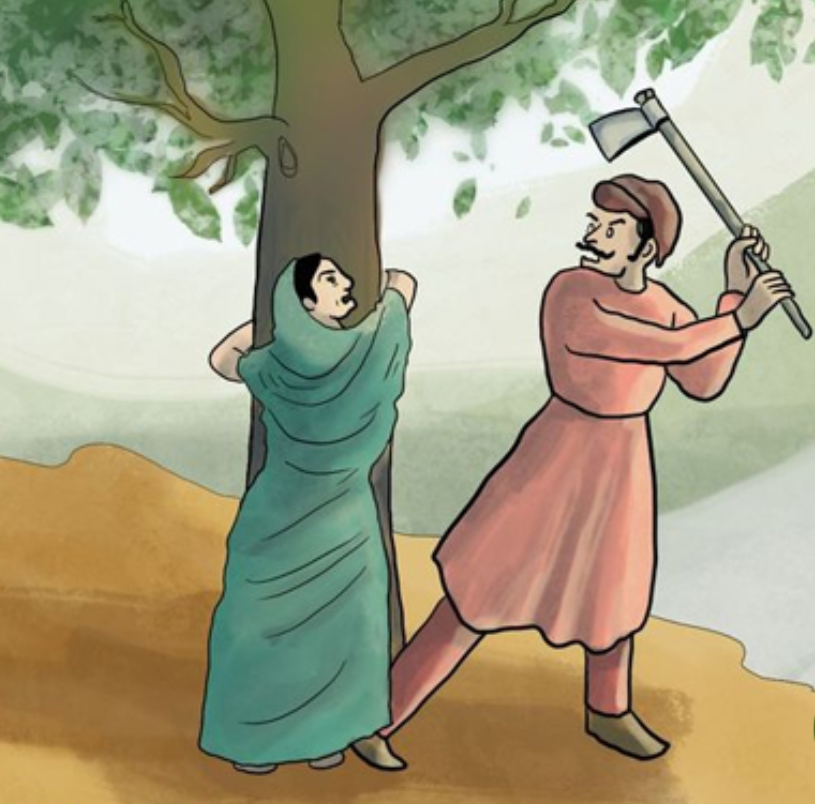
September 11th is a day of solemn commemoration in India. Not for the reason that would probably immediately spring to the minds of most non-Indians upon seeing the date. For years, it has been India’s National Forest Martyrs Day, to observe a massacre of literal tree huggers. Below are some interesting facts about that tragic event.
The Limitations of Civil Disobedience

Civil disobedience can prove powerfully effective at changing the world for the better. Take for example the nonviolent movements led by Mahatma Gandhi in India or Dr. Martin Luther King in America. By any measure, they helped bring about change for the better. However, civil disobedience is not effective against all forms of oppression, or against all types of oppressors. It only works in societies and against governments that are susceptible to such campaigns of moral pressure.
Civil disobedience can produce results in grounds that are fertile for such a strategy. It needs a bare minimum of civil society, bare minimum rule of law, and governments that have a bare minimum of respect for the essentials of civil rights. Or at least government that have a bare minimum of fear of the public’s reaction if such rights are too flagrantly flouted. Moral persuasion is effective when dealing with those susceptible to moral persuasion and are willing to engage those who engage in civil disobedience. Absent such preconditions, civil disobedience can prove catastrophic, as happened when Indian villagers hugged sacred trees in a bid to protect them from an evil ruler, Maharaja Abhai Singh of Marwar.
The Maharaja Who Massacred Tree Huggers

Civil disobedience is not that effective against rulers who can’t care less about justice or the need to treat their subjects humanely. Especially when such rulers have the power to enforce their will no matter what anybody thinks. In such circumstances, civil disobedience can produce horrific results. Take for example eighteenth century Indian Maharaja Abhai Singh of Marwar (1702 – 1749). A nasty piece of work, Singh had seized power in 1724 after he conspired with his brother to murder the previous maharaja – their father.
In 1730, Singh needed wood for a new palace, and the forest near the village of Jehnad seemed like a good source. However, the forest was sacred to the locals. So they literally hugged the trees to keep them from being cut. Singh simply ordered the tree huggers beheaded, and for the timber to be collected anyhow. When other protesters from nearby villages showed up to hug the trees in a bid to save them, the maharaja’s men sawed right through them to get to the trees. All in all, 363 were slaughtered to get lumber for Singh’s palace. The anniversary of what came to be known as the Khejarli Massacre is commemorated in modern India as National Forest Martyrs Day every September 11th.

_________________
Some Sources & Further Reading
Encyclopedia Britannica – Civil Disobedience

