[This is the second and final of two articles about the destruction of the Egyptian Mamluks. For Part I, click here]
After years of uneasy peace with the Mamluks, Muhammad Ali Pasha prepared to finally destroy once and for all the slave soldiers who had dominated Egypt for centuries. As seen below, their end was quite dramatic.
The Mamluks’ Worst Mistake: Accepting an Invitation From Muhammad Ali Pasha

An Egyptian army was organized in 1811 to campaign against the Wahhabis in the Arabian Peninsula. During a lull in tensions between Muhammad Ali Pasha and the Mamluks, the latter were invited to a ceremony in the Cairo Citadel to invest the governor’s younger son, Ahmed Tusun Pasha, with the army’s command. In what turned out to be a fatal mistake, they accepted. On the morning of March 1st, 1811, six hundred to seven hundred prominent Mamluks showed up. Dressed in ceremonial finery and armed with shining gilded swords, they rode their best horses, richly caparisoned, to the Citadel. There, they were warmly greeted in the courtyard by Muhammad Ali.
As the Mamluks were presented with coffee and hookah pipes, the Pasha engaged them in casual and friendly conversations. Finally, their host rose, a signal to end the ceremony. The guests then mounted their horses, and formed in a procession preceded and followed by Muhammad Ali’s troops. It was planned that they would ride through Cairo to be seen by the crowds that lined the streets, until they reached the departing army’s camp, where a celebratory feast was to be held. As seen below, none of the Mamluks got there.
Trapping the Mamluks

The procession wound its way down a steep and narrow road to the Cairo Citadel’s great gate, Bab al Azab. Muhammad Ali Pasha’s troops headed the procession, led by his son, the recently invested army commander Tusun, exited the Citadel. Soon as the Mamluks reached the gate, however, it was slammed shut before them. Simultaneously, the troops behind them raced back to close the exit to the rear. The Mamluks, confined along a narrow path, milled about in confusion before the closed gate. Then, a signal was given to begin their final eradication.
Albanian troops loyal to Muhammad Ali, placed on the rooftops of nearby buildings that overlooked the trapped Mamluks, opened fire. His son Tusun Pasha had not been informed of what was about to happen. He heard gunfire, and looked behind at the Cairo Citadel whose gate had been slammed shut. He feared that a rebellion was taking place against his father, and that the rebels would come for him next. Tosun was finally assured by one of his father’s closest aides that he was safe, and that the gunfire was directed at the Mamluks, on his father’s orders.
The Mamluks’ Final Feast

An eyewitness described wat happened to the Mamluks: “It was only moments before the narrow path was crowded with the corpses of men and horses, lying on top of each other, making any movement even more difficult than before. As for the Mamelukes who happened to reach the portal Bab al-Azab, they found it closed and turned back their horses. But this caused even more chaos amongst the men and horses that were at the top of the incline, and they in turn tried to turn their horses back to the Citadel away from the bullets.
However, the infantry spread across the walls opened fire, killing them in droves and the mayhem and horror increased. The Mamelukes soon realized that their horses were useless and so they descended to walk on foot and took off their clothes and finery which only hindered their movements at that terrible time. They started to run, swords and firearms in hand, wanting to meet an enemy to take their revenge for the catastrophe which had befallen them. But they found no-one and the bullets continued to rain down upon them hitting their mark.”
A Miraculous Survival
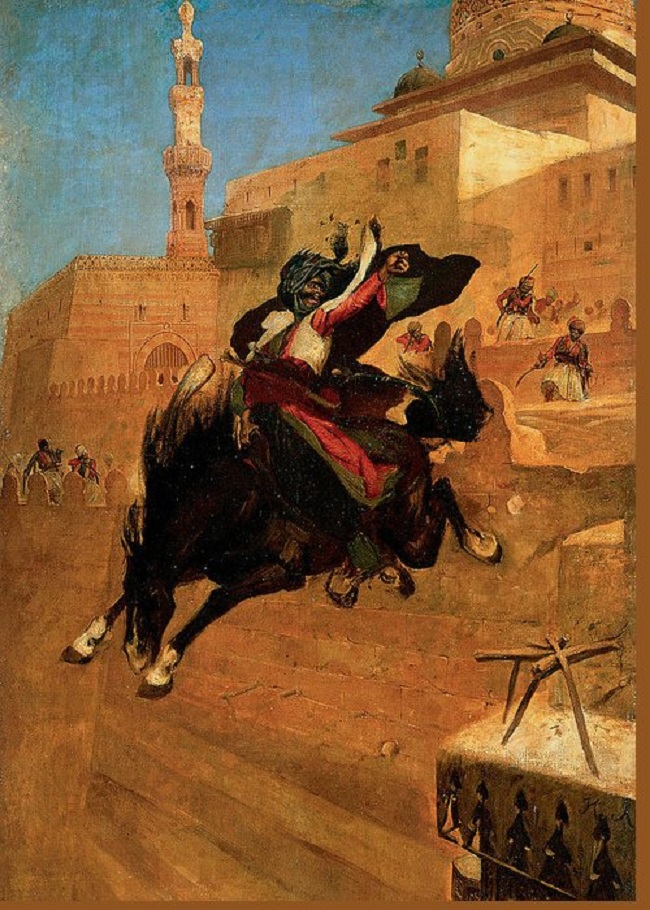
Six hundred to seven hundred prominent Mamluks entered Cairo’s Citadel on March 1st, 1811. Only one, Amin Bek, is reported to have survived the massacre. He was at the back of the procession when the gate was slammed shut. As death closed in upon him from all sides, he spurred his horse and jumped from one of the Citadel’s walls, from a height of about 65 feet – equivalent to the seventh floor of a modern building. The horse died, but Amin Bek miraculously survived, and managed to escape to Syria.
The Extermination of the Mamluks

The massacre at the Citadel was the start of a widespread slaughter of Mamluks throughout Egypt. Muhammad Ali Pasha had instructed subordinates throughout the country to be ready, and when word arrived, they fanned out to slay any Mamluks they could lay their hands on. In Cairo, the Pasha’s soldiers began to loot Mamluk houses, and by the time order and discipline were restored among the troops, over five hundred houses had been pillaged and trashed. The extermination of the Mamluk remnants was then entrusted to Muhammad Ali’s oldest son, Ibrahim, who led expeditions throughout the country over the next two years to finish the task.
That explained a mystery that had made many contemporaries scratch their heads: why had Muhammad Ali appointed his younger son Tusun to invade the Arabian Peninsula, instead of his older son and right hand man, Ibrahim? Getting rid of the Mamluks was a higher priority for the Egyptian ruler than the expedition to the Arabian Peninsula, so he kept the capable and trusted Ibrahim in Egypt for that. A few Mamluk survivors fled south to Nubia, but even that refuge was lost to them in 1820, when the Pasha’s troops invaded and conquered the region. With the Mamluks finally destroyed once and for all, Muhammad Ali went on to create modern Egypt, and founded a dynasty that ruled the country until 1952.

_________________
Some Sources & Further Reading
Dodwell, Henry – The Founder of Modern Egypt: A Study of Muhammad Ali (1931)
History Halls – The Mamluks: The Slave Soldiers Who Ruled Medieval Egypt
Rawi, Egypt’s Heritage Review – Coffee With the Pasha: The Story of Egypt’s Most Famous Massacre

