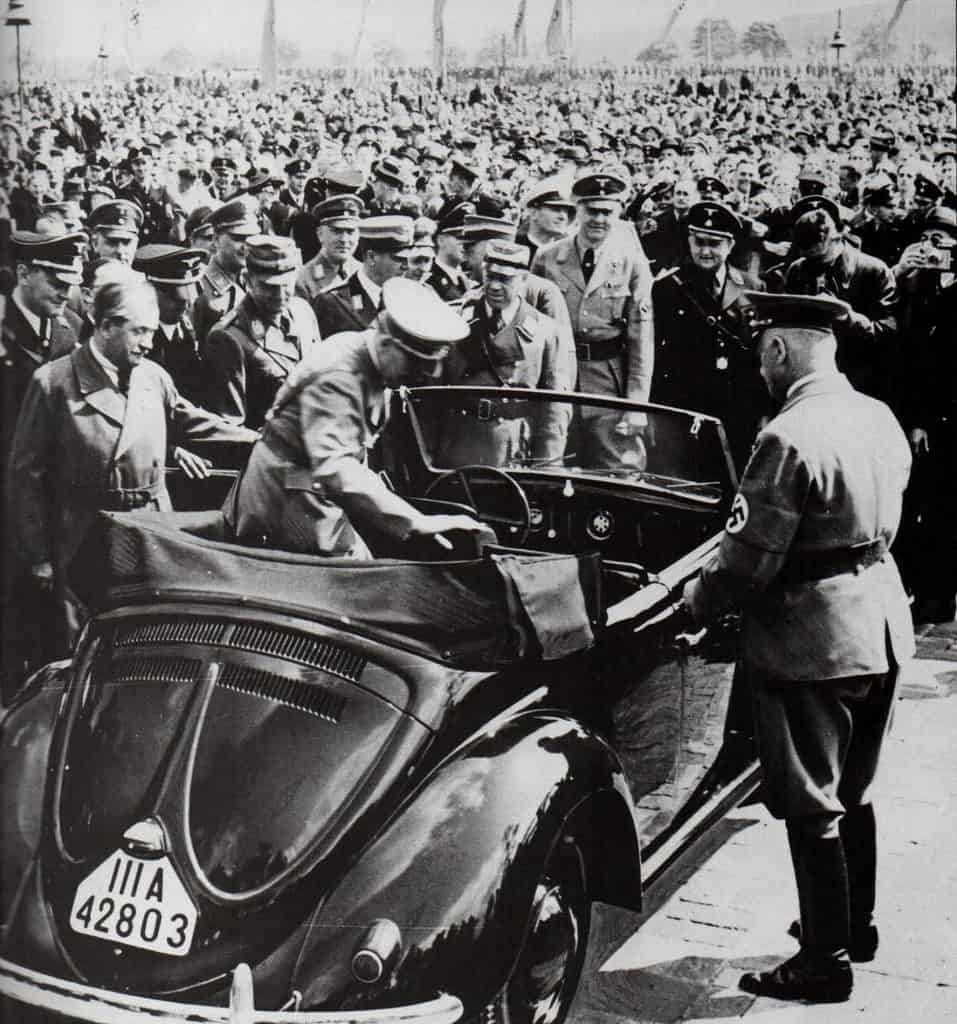
In 2016, Volkswagen took the lead from Toyota as the world’s biggest car manufacturer. It has been in competition with the Japanese carmaker for the top rank ever since. In 2024, VW posted revenues of $352 billion – a figure it expects to increase by 5% in 2025. The German company, whose iconic Beetle is so cute and popular it became the star of Disney’s Herbie the Love Bug movie franchise, came a long way from its Nazi origins. Indeed, the VW Beetle owes its creation to two men: Adolf Hitler, for whom Volkswagen was a pet project, and engineer Ferdinand Porsche, who set out to bring the Fuhrer’s vision to life.
“People’s Car” (Volks Wagen) Projects

Germany’s automobile industry in the 1930s was geared towards luxury cars that most Germans could not afford. There was no domestic equivalent of the mass produced and affordable Ford Model-T. As a result, average Germans had to either make do with motorcycles for personal transport, or do without and rely on public transportation instead. Most did without private transport, and only two percent of Germans owned a car. Such a low rate of car ownership made Germany a huge potential market for an affordable automobile.
Many sought to capitalize on that potential through “people’s car” projects (volks wagen in German). One such was Ferdinand Porsche, a well-known race car and luxury automobile designer, who tried to interest manufacturers in his idea for a small and affordable family car. In 1933, Porsche built his concept car, a forerunner of the VW Beetle, which he named the Volksauto. It had a torsion suspension, and a beetle shape, with a rounded front hood for better aerodynamics to compensate in part for a small air cooled rear engine.
VW Became Hitler’s Pet Project

After the Nazis came into power in 1933, Adolf Hitler jumped on the “people’s car” bandwagon. In February, 1933, just weeks after he became Reich Chancellor, he announced plans for a “people’s motorization”. In 1934, the Fuhrer issued a decree for the production of a basic car that could transport two adults and three children at 62 miles per hour, and cost only 990 Reichsmarks – about U$400 in the 1930s. Germany’s established carmakers thought the cost was unrealistic, and none submitted a bid.
Ferdinand Porsche, however, was enthusiastic about the project, and Hitler fell in love with his design. However, even in a command economy in which the government could order businesses about, Germany’s auto industry could not manufacture a car for 990 Reichsmarks in its existing plants. So Hitler ordered the construction of a state-owned factory to produce the Volkswagen. Those who wanted a People’s Car were to pay for it through a savings plan of about 5 Reischmarks a week, at a time when average weekly income was about 32 RM. That placed the new car within the financial means of most Germans.
The Nazis Screwed Those Who Paid Deposits for Volkswagens

Construction of the new factory began in May, 1938, in Wolfsburg, a new town that was purpose built for Volkswagen workers. Today, Wolfsburg is Germany’s richest city, with a GDP per capita of about U$185,000 because of its thriving auto industry. However, only a few People’s Cars had been built when World War II began in 1939. The factory retooled from consumer cars to military manufacture, and pumped out the VW Kubelwagen, the German military’s clunky answer to the Jeep. No Germans who had placed an order for a VW before the war received their car. None who sought a refund after WWII of their deposit and installment payments got their money back.
After the war, Volkswagen resumed civilian production. The company was offered to American, British, and French car manufacturers, all of whom rejected it – including Ford, who declined even though it was offered free of charge. By 1946, VW was producing about 1000 car a month – although at the time, all cars produced went to Allied occupation authorities. By 1948, Volkswagens were available to consumers, VW was becoming an icon of West Germany’s economic revival, and beginning its rise to global automotive dominance.

_________________
Some Sources & Further Reading
Encyclopedia Britannica – Volkswagen Group
Hiott, Andrea – Thinking Small: The Long, Strange Trip of the Volkswagen Beetle (2012)
History Halls – The Keely Engine Proved That Gibberish Sells if it Sounds Like Science

