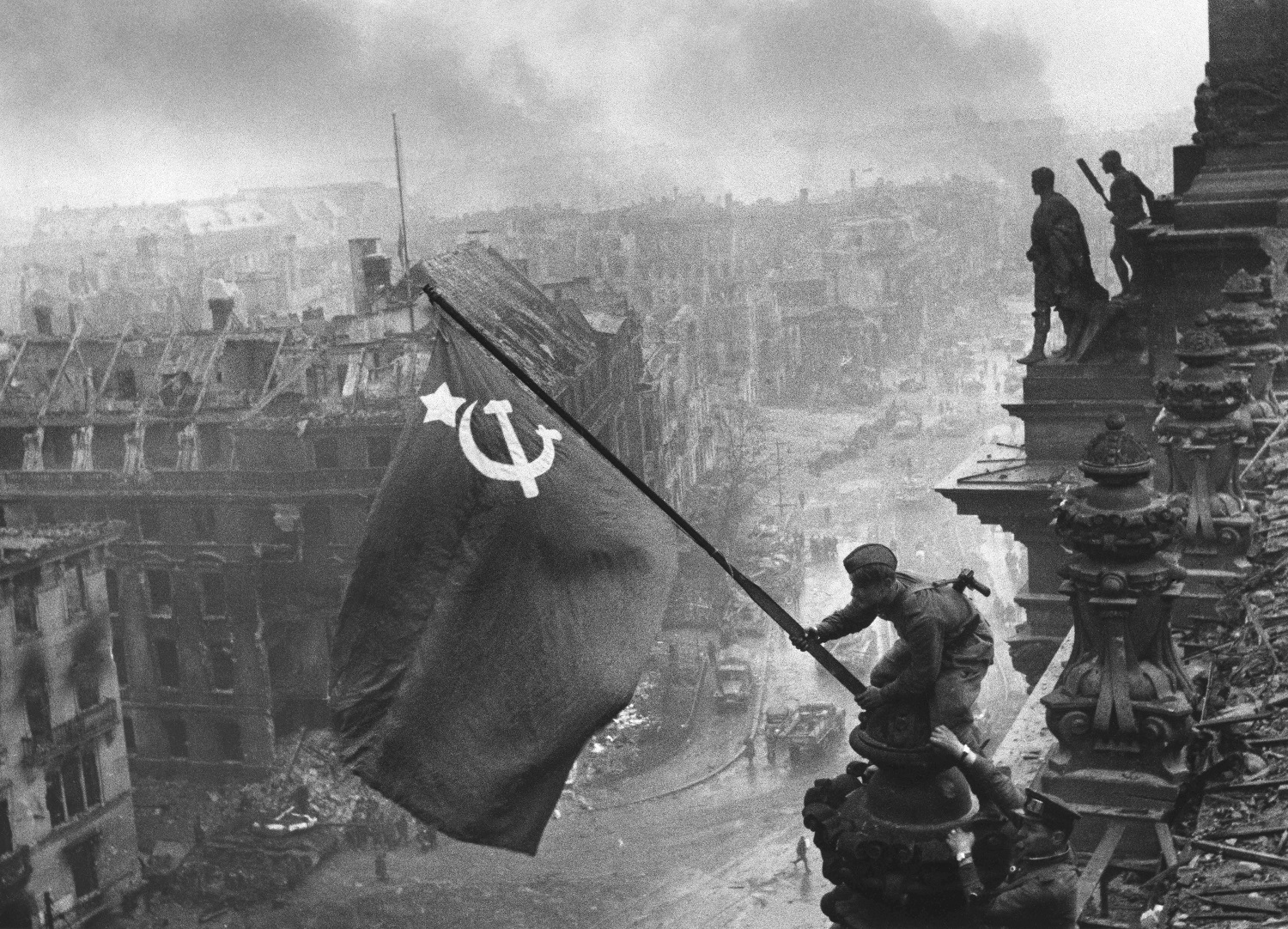
One of the best known World War II photographs is Raising a Flag Over the Reichstag. The dramatic image shows victorious Red Army soldiers affixing the Soviet flag over the Reichstag building in Berlin on May 2nd, 1945, towards the end of WWII in Europe. It became the symbol of Soviet victory over Nazi Germany. Reprinted in thousands of publications, it became one of the most recognizable images of the Second World War. Below are some interesting facts about the background of that iconic image.
The High Price of Victory

Few knew better than the men and women of the Red Army in WWII that victory does not come cheap. Their country had survived a surprise Nazi onslaught in June of 1941 only by dint of superhuman sacrifices and tenacity. In just the war’s first six months, the Red Army lost about five million personnel. Civilian losses amounted to millions more. Forced to retreat until the enemy came within literal sight of the Kremlin in the winter of 1941, they managed to hang on by the skin of their teeth, before they beat the Germans back from the gates of Moscow.
They endured another onslaught the following year that brought the Germans all the way to the Volga River. It took still more epic sacrifice before the tide was turned with a Soviet comeback victory at Stalingrad. They then clawed their way back, fighting gargantuan battles and campaigns to beat back the Germans until they reached Berlin. By war’s end, four fifths of Germans killed had met their fate on the Eastern Front, while all the other Allies combined – American, British, French, etc – accounted for only one fifth. It did not come cheap. Estimated Soviet dead range from twenty five million at the conservative end, to a high of forty million or more.
The Capture of the Reichstag Building

That was the backdrop against which photographer Yevgeney Khaldei arrived in Berlin in 1945. At the time, the Red Army was blasting its way into the heart of the Third Reich’s capital. He brought with him his trusted Leica III rangefinder camera, and a massive Soviet flag sewn out of red tablecloths by his uncle, a tailor. On April 30th, 1945, Soviet journalists had heard from various sources that their forces had captured the Reichstag, the German legislature’s building, and that a Soviet flag now flew over the edifice.
When they got there to cover the story, however, they discovered that the building had not, in fact, fallen. Instead, the Reichstag was still in the hands of feisty Germans, who were still full of fight. They opened fire on the approaching journalists, and pinned them down. It was not until May 2nd, 1945, that the Red Army was able to fully secure the building. Khaldei headed there, and upon arrival, asked some soldiers who were passing by to help him stage a photo shoot.
Shooting – and Doctoring – an Iconic Photo

Khaldei and the soldiers headed to the building’s roof, and there, with the burning ruins of Berlin spread below, he captured on camera the most famous Soviet image of the war, Raising a Flag Over the Reichstag. It depicts three Red Army soldiers, Aleksei Kovalev of the Kazakh SSR, hoisting the flag, Abdulkhakim Ismailov from Dagestan, and Leonid Gorychev, from Minsk. As Khaldei described the event: “this is what I had been waiting for for 1400 days”. He rushed back to Moscow, where a problem was discovered: Ismailov was shown with two watches, one on each wrist.
That could imply that Ismailov had looted them – which would not have been a look. The Red Army at the time was facing accusations of massive looting and assaults and mistreatment of civilians in the liberated lands. To avoid controversy, Khaldei hurriedly used a needle to scrape one of the watches off of Ismailov’s right wrist. The doctored photo was then released to the public, and swiftly took the world by storm and took its place among the ranks of history’s most iconic images.

_________________
Some Sources & Further Reading
Adams, Simon – The Eastern Front (2009)
History Halls – The Story Behind an Iconic Photo: ‘Lunch Atop a Skyscraper’
Spiegel, May 7th, 2008 – The Art of Soviet Propaganda: Iconic Red Army Reichstag Photo Staged

