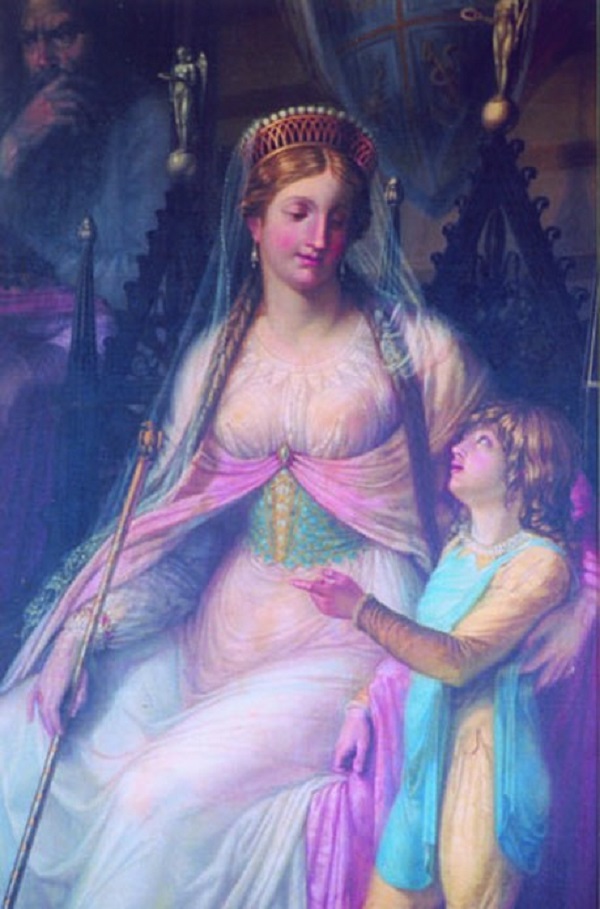
Sikelgaita of Salerno was the female half of a medieval power couple that roiled the Mediterranean world for decades in the eleventh century. A warrior princess, she fought at the head of armies, terrified the Byzantine Empire, and led charges that turned the tide of battles. Below are some remarkable fact about this remarkable warrior woman.
A Medieval Amazon

Sikelgaita of Salerno (circa 1040 – 1090) was a Lombard warrior princess and the hereditary duchess of Apulia in southern Italy. A six foot Amazon, she met and married Robert Guiscard, a Norman adventurer who turned southern Italy and Sicily into a Norman domain. Armed and armored and going into combat at Guiscard’s side, or leading men into battle on her own, the power couple roiled the Mediterranean world during the second half of the eleventh century.
Sikelgaita was born into the ruling family of the Duchy of Salerno. From an early age, she exhibited a passion for swordsmanship and horseback riding. After her father, the duke, was murdered in a palace coup, she helped her brother regain the duchy, and she regained her place as the duchy’s most privileged woman. Brother and sister then had to deal with encroachment from Normans to their south, who had settled in Italy following a pilgrimage to Jerusalem.
A Medieval Power Couple

In 1058, Sikelgaita met the Normans’ leader, Robert Guiscard, and the two fell passionately in love. Impressed by the six foot Amazon who went into battle, armed and armored at his side, Guiscard divorced his wife and married Sikelgaita. For the next eighteen years, she was Guiscard’s constant companion, on and off the battlefield, helping consolidate his and her family’s hold on southern Italy.
In 1076, clad in shining armor and mounted astride a stallion, Sikelgaita rode up to the walls of Salerno, which was ruled by her own brother, and demanded the city’s submission. When her brother refused, Sikelgaita and Guiscard put the city under siege, and starved him into surrender. She then took command of the city, and sent her brother into exile.
Sikelgaita Led Men Into Battle

In addition to fighting at her husband’s side, Sikelgaita also led men on her own in independent commands. She and Guiscard attempted to take over the Byzantine Empire by marrying one of their children into the imperial household. A palace coup in Constantinople foiled those plans, however. S the power couple decided to take over Byzantium the hard way, by conquering it.
Sikelgaita’s greatest exploit came during the ensuing war, at the Battle of Durazo on the Albanian coast, in October, 1081. She led an advance force ahead of the main body, which encountered a powerful Byzantine army that offered fierce resistance. Sikelgaita pressed the attack to keep the Byzantines pinned in place until Guiscard arrived with reinforcements. As seen below, however, her men faltered, and some fled.
A Ferocious Fighting Woman

As described by near contemporaries: “Directly Sikelgaita, Robert’s wife (who was riding at his side and was a second Pallas, if not an Athene) saw these soldiers running away. She looked fiercely after them and in a very powerful voice called out to them in her own language an equivalent to Homer’s words “How far will ye flee? Stand and fight like men!” And when she saw that they continued to run, she grasped a long spear and at full gallop rushed after the fugitives; and on seeing this they recovered themselves and returned to the fight.” She was badly wounded in the fight, but held part of the battlefield until reinforcements arrived to turn the tide and win the hard-fought engagement.
Despite that the plans for conquering Byzantium had to be discarded because of developments back in Italy. A conflict broke out between the Pope and the Holy Roman Emperor, that upended many things. In 1084, the power couple resumed the attempted conquest of Byzantium. They won some initial victories, including a ferocious naval battle against a combined Venetian-Byzantine. That gained them the islands of Corfu and Cefalonia. Soon thereafter, however, Guiscard took ill and died in 1085, and the campaign in Greece fizzled out. Sikelgaita retired to Salerno, where she died five years later, in 1090.

_________________
Some Sources & Further Reading
History Halls – Artemisia I of Caria
Journal of Medieval History, Volume III (2005) – Sichelgaita of Salerno: Amazon or Trophy Wife?

