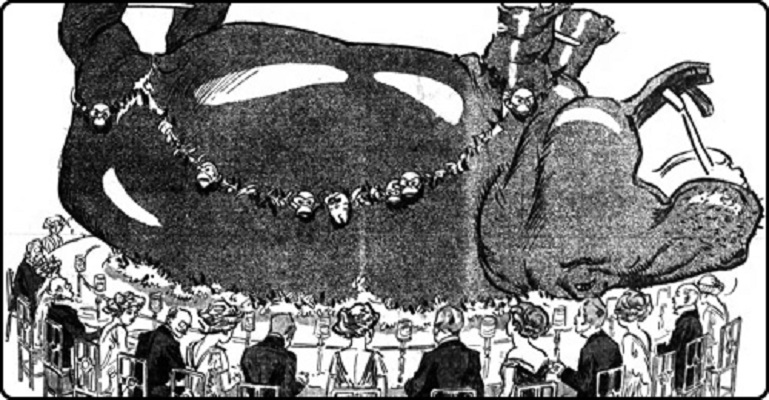
The United States faced a meat shortage in the early twentieth century. Beef prices exploded, as producers struggled to meet the increased demand from a growing population. Between natural increase and waves of new immigrants, America had many more mouths to feed, many of which wanted meat. However, cattle ranges had suffered from decades of overgrazing. Herds shrank, and cattle numbers dropped by millions every year. The “Meat Question” became a serious issue, that occupied the minds of consumers, pundits, and politicians. Things seemed so dire, that there were even worries of a potential famine unless a solution was found. Such fears, as seen below, prompted serious consideration of hippopotamus ranches.
“The Meat Question” Generated Some Radical Answers

Amidst worries of a meat shortage and even a potential famine, an idea began to bubble up: hippopotamus meat. Why not import hippos from Africa, release them in the Gulf Coast’s swamplands and deltas, and raise them for food? Hippos were full of blubbery goodness, so why not turn America into a nation of hippopotamus ranchers? Many saw that as a great answer to the Meat Question. A US Department of Agriculture researcher figured that the answer to the country’s meat shortage lay in the exploitation of unproductive lands to produce food.
The swamps along the country’s Gulf Coast were highly unproductive. However, that could change if hippos were introduced there. Free range hippopotamuses set loose in the Gulf Coast’s swamps and bayous, especially those of Louisiana, could easily yield a million tons of meat per year. Although many folk knew that that ranching hippos in America sounded crazy, they thought it was necessary.

Much of the country’s media was on board with the idea. A Washington Post editorial noted that eating crabs and raw oysters was no less weird than eating hippopotamus meat, but people did it all the time. It went on to add: “Proposals which at first may look odd and chimerical to the mass of our readers will be seen to be matter-of-fact propositions when they become familiar”. The New York Times gushed about how fatty hippo meat could be cured into “lake cow bacon”.
Hippopotamus Ranching

Another publication wrote in endorsement of the plan: “This animal, homely as a steam-roller, [is] the embodiment of salvation … Peace, plenty, and contentment lie before us; and a new life, with new experiences, new opportunities, new vigor, new romance, folded in that golden future when the meadows and the bayous of our Southern lands shall swarm with herds of hippopotami”. Many prominent Americans, including former president Teddy Roosevelt, supported plans to ranch hippos.
A Louisiana congressman introduced HR 23261 in 1910. It became known as “The Hippo Bill”. Louisiana seemed particularly suitable. Its waterways were clogged by invasive hyacinths, and hippos could gorge on them, killing two birds with one stone: clear the waterways, and simultaneously supply Americans with millions of tons of meat. Gulf Coast hippopotamuses could also end Chicago’s monopoly on meat packing – a desirable outcome for much of the rest of America.
Unfortunately – or fortunately, depending on one’s perspective – the Hippo Bill languished in committee purgatory. When World War I broke out a few years later, it took attention away from the plan. The Meat Question was eventually answered in a less spectacular way than setting hippopotamuses loose in Louisiana’s and the Gulf Coast’s bayous. The Department of Agriculture simply expanded pastures, and cattle ranchers stocked the newly-available land with boring cows.

_________________
Some Sources & Further Reading
Atavist – American Hippopotamus: A Bracing and Eccentric Epic of Espionage and Hippos
History Halls – Moral Panics: When Coffee Was Controversial
Wired – The Crazy, Ingenious Plan to Bring Hippopotamus Ranching to America

