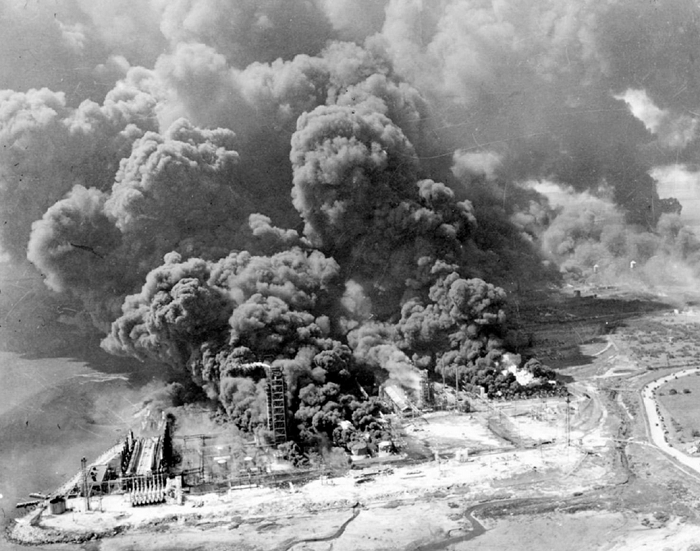
On the morning of April 16th, 1947, the bustling port city of Texas City, Texas, suffered the most catastrophic industrial disaster in American history. What began as an ordinary workday quickly escalated into a disaster through a sequence of explosions and fires that devastated the city, killed hundreds, and left thousands injured. The tragedy, now remembered as the Texas City Disaster, remains a grim lesson about industrial safety, hazardous materials, and the dangers of complacency in handling volatile cargo.
A Ship Loaded With Ammonium Nitrate

Texas City, located on the Gulf of Mexico, was a busy and bustling hub of the petrochemical and shipping industries in the mid-twentieth century. Its strategic location made it an ideal port for refining and exporting petroleum and chemicals. In 1947, America was still transitioning from wartime production to peacetime industry. Chemicals such as ammonium nitrate, heavily used in wartime explosives, were now being manufactured in large quantities for agricultural fertilizer. However, ammonium nitrate is highly unstable when exposed to heat and pressure.
If it is stored improperly, ammonium nitrate can detonate with devastating force. That risk was not fully appreciated at the time, despite smaller-scale accidents in Europe that had already demonstrated its dangers. At the center of the disaster was the SS Grandcamp, a French-owned Liberty ship docked in Texas City. On April 16th, 1947, it was being loaded with ammonium nitrate fertilizer, packed in paper sacks that weighed about 100 pounds each. More than 2,300 tons of the material was stored in the ship’s hold.
A Firefighting Mistake That Transformed a Ship Into a Giant Bomb

April 16th, 1947, began uneventfully, until dockworkers noticed smoke seeping from the Grandcamp’s cargo hold around 8:00 AM. The crew believed it was a small fire, and tried to contain with fire extinguishers and throwing water at it with a gallon jug. The captain, however, was worried about ruining the cargo, and told them to stop. Instead, he ordered the cargo hold’s hatches sealed, and released steam into the enclosed space to try and smother the fire. That turned out to be a huge mistake: steam had no fire-extinguishing effect in this case.
Smothering a fire works by depriving it of oxygen, but ammonium nitrate is an oxidizer: it doesn’t need outside oxygen, because it makes its own. Not only did the steam not smother the fire, it heated the ammonium nitrate and increased the pressure inside the cargo hold. Heat and pressure are the ideal catalysts for explosion, so the Grandcamp’s cargo hold became a ticking bomb. Around 8:30 AM the steam had raised the pressure inside the hold so much, that the hatches blew off.
The Massive Explosion that Started the Texas City Disaster

By 9:00 AM, the fire had attracted a crowd of spectators, including refinery workers, townspeople, and even children on their way to school. The orange flames and rising smoke made the Grandcamp look ominous, but few grasped just how dangerous the situation was. Some reported seeing bags of fertilizer start to “jump” as the chemical inside grew unstable. At 9:12 AM, the ammonium nitrate finally detonated. The explosion, when it came. was extraordinarily powerful – one of history’s biggest non-nuclear blasts. It instantly obliterated the Grandcamp, and sent its two-ton anchor hurtling into the air. It landed more than 1.6 miles away, with an impact that created a ten-foot-deep crater.
The blast sent a towering mushroom cloud 2,000 feet high into the sky. Windows shattered in Houston, forty miles away, and the explosion was felt in Louisiana and distant Oklahoma. The immediate devastation was unimaginable. Dockworkers, firefighters, and spectators closest to the ship were vaporized or killed instantly. Texas City’s volunteer fire department was at the scene. Of its 28 firefighters, 27 perished in the blast. Four firefighters from Texas City Heights Volunteer Fire Department were also on the docks. Only one of them survived.
A Second Powerful Detonation

Nearby refineries and chemical plants erupted into massive infernos. The explosion created a 15-foot tsunami, which swept onto the docks, destroying small boats and damaging structures along the shoreline. The Grandcamp’s detonation was just the first of multiple explosions in what came to be known as the Texas City Disaster. Fiery debris was scattered across the industrial district, and set storage tanks, pipelines, and other ships ablaze. The SS High Flyer, another Liberty ship docked only 600 feet away, was loaded with 961 tons of ammonium nitrate, and 1,800 tons of sulfur.
The blast severely damaged the High Flyer, which caught fire and became another ticking bomb. Her mooring lines were severed, and she drifted across the harbor until she came to rest next to another Liberty Ship, the SS Wilson B. Keene. For the next 15 hours, firefighters, of whom many had already perished in the first explosion, struggled desperately to control the inferno. Their efforts were heroic but ultimately futile. At 1:10 AM on April 17th, the High Flyer detonated. That explosion, though smaller than Grandcamp’s, was still catastrophic.
The High Cost of the Texas City Disaster

The explosion of the High Flyer destroyed the nearby Wilson B. Keene, wrecked more of the port, and spread fires deeper into the city. The human cost of the Texas City Disaster was staggering. Officially, 581 people were confirmed dead. However, the true number was likely higher, because many bodies were never recovered. At least 5,000 people were injured, and the casualties overwhelmed hospitals in Galveston County and neighboring areas. The seaport was demolished, some 1,500 houses were destroyed or severely damaged, and thousands were made homeless. More than 1,100 vehicles were wrecked, along with 362 freight cars. Economic losses came to around $1.2 billion in 2025 dollars in property damage, plus another $6 billion in burned oil products.
Many victims were firefighters and industrial workers who had rushed to the scene after the fire was spotted. The sheer scale of destruction meant that victim identification was often impossible. Mass graves were used for those who could not be named. In the aftermath of the Texas City Disaster, the city looked like a war zone. Fires raged for days, and rescuers worked tirelessly to recover bodies and search for survivors. Medical personnel from all over Texas and across the country, along with the Red Cross, military units, and volunteers, poured into the city to assist. The federal government, recognizing the enormity of the disaster, mobilized resources for relief. President Harry S. Truman sent aid, and the US Army, Coast Guard, and Navy provided support to clear the wreckage and treat the wounded.
A Catastrophe That Led to Greater Awareness of Industrial Dangers

The Texas City Disaster raised urgent questions about safety standards in shipping and industrial operations. Lawsuits were filed against the US government, since the ammonium nitrate had been manufactured under federal supervision. In what became the first class action lawsuit against the US government, survivors and victims’ families sued under the Federal Tort Claims Act of 1946. Although the government was initially found liable, an appellate court overturned that decision, in a ruling that was upheld by the US Supreme Court. The legal battle highlighted the complexity of assigning blame in industrial catastrophes.
The Texas City Disaster underscored the dangers of ammonium nitrate, and led to tighter regulations on its storage and transportation. Safety protocols were improved, including better firefighting methods for chemical fires and stricter handling requirements for hazardous materials. Industrial zones began to develop more rigorous disaster preparedness plans. However, history has shown that the lessons were not always heeded. Decades later, ammonium nitrate was implicated in other deadly explosions. In the 1995 Oklahoma City Bombing, too-easy access to the substance enabled terrorists to manufacture a massive truck bomb. In the 2020 Beirut Port Explosion, negligence and sloppy storage of ammonium nitrate set the stage for a blast that demolished much of the city.
Legacy of the Texas City Disaster

Today, Texas City remembers the disaster with solemnity. A memorial stands in the city to honor the victims, and the story continues to be taught as a reminder of the importance of industrial safety and vigilance. Survivors’ accounts, preserved in archives and oral histories, convey the horror of that morning, when the ordinary rhythm of life was shattered in an instant. The disaster reshaped Texas City. The community rebuilt, and its petrochemical industry grew again. However, the scars – both physical and emotional – remained for decades.
The event left a deep imprint not only on the city but also on American industrial history. It serves as a cautionary tale about the dangers inherent in the handling of volatile chemicals. The Texas City Disaster of 1947 remains the deadliest industrial accident in US history. It was a tragic convergence of human error, hazardous materials, and inadequate safety awareness. With nearly 600 lives lost, thousands injured, and a city shattered, it revealed the catastrophic potential of modern industry when safety is neglected. The lessons it taught about chemical handling, emergency response, and legal accountability continue to resonate. They remind us that progress and profits should always be tempered with caution.

_________________
Some Sources & Further Reading
History Halls – Hotel New World Collapse: When DIY Designs by Unqualified Architects Led to Disaster
Houston Chronicle, April 13th, 1997 – The Explosion: 50 Years Later, Texas City Still Remembers
International Association of Firefighters, Local 1259 – The Texas City Disaster, April 16, 1947

